Dreiecke, Kreise, Koordinaten, Trigonometrie und Volumen.
Das Wichtigste
SOH-CAH-TOA: sin = Gegenkathete/Hypotenuse.
Kreis: (x−h)2+(y−k)2=r2; quadratische Ergänzung.
Abstand: (Δx)2+(Δy)2. Zylinder: V=πr2h.
Strategie Schritt für Schritt
Mach eine Skizze und beschrifte, was du weißt.
Typische Fallen
r2 statt r angeben oder den Durchmesser statt des Radius.
Gelöstes Beispiel
x2+y2−6x+8y=0 → (x−3)2+(y+4)2=25 → r=5.
Beispielfragen
Versuche zu antworten, bevor du die Lösung öffnest. Die Fragen sind in der Prüfungssprache.
Frage 1
Schwierigkeit: leicht≈ 1 min
What is the area, in square centimeters, of a circle with a diameter of 10 centimeters?
AA. 10π
BB. 25π
CC. 50π
DD. 100π
Antwort und Erklärung anzeigen
Richtige Antwort: B. 25π
Erklärung
The radius is half the diameter, so r=5 cm. The area is πr2=π⋅52=25π square centimeters.
10π is the circumference (πd). 50π uses 2πr2 or doubles the area. 100π uses the diameter in place of the radius (π⋅102).
Frage 2
Schwierigkeit: mittel≈ 1 min
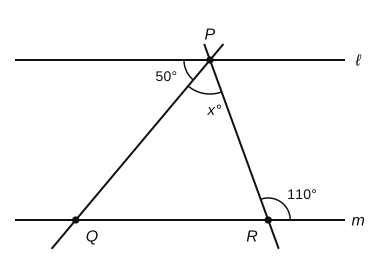
In the figure above, line ℓ is parallel to line m. What is the value of x ?
AA. 60
BB. 70
CC. 110
DD. 130
Antwort und Erklärung anzeigen
Richtige Antwort: A. 60
Erklärung
Alternate interior angles: ∠PQR=50∘. The 110∘ angle at R is supplementary to ∠PRQ, so ∠PRQ=70∘. In triangle PQR: x=180−50−70=60.
70 is ∠PRQ, not ∠QPR. 130 is the supplement of the 50∘ angle, the angle between PQ and line ℓ on the other side. 110 is the exterior angle at R, which equals 50+x (exterior angle theorem), not x.
Frage 3
Schwierigkeit: schwer≈ 1 min
The equation x2+y2−8x+6y=11 describes a circle. How long is its radius?
AA. 11
BB. 5
CC. 6
DD. 36
Antwort und Erklärung anzeigen
Richtige Antwort: C. 6
Erklärung
Complete the squares: (x2−8x+16)+(y2+6y+9)=11+16+9, so (x−4)2+(y+3)2=36. The radius is 36=6.
36 is the square of the radius, 11 ignores the completed squares, and 5=16+9 is the distance from the center to the origin.