f' changes sign at extrema and f'' at inflections.
Strategie Schritt für Schritt
On a closed interval, compare critical points and endpoints.
Typische Fallen
Claiming a maximum without checking the sign change.
Beispielfragen
Versuche zu antworten, bevor du die Lösung öffnest. Die Fragen sind in der Prüfungssprache.
Frage 1
Schwierigkeit: mittel≈ 2 min
Let f(x)=2x3−15x2+24x. At what value of x does f have a relative maximum?
AA. 1
BB. 4
CC. 5
DD. 0
Antwort und Erklärung anzeigen
Richtige Antwort: A. 1
Erklärung
f′(x)=6(x−1)(x−4) is positive, then negative between the roots, then positive. The sign change from + to − occurs at x = 1, the smaller root; the larger root is a relative minimum.
Frage 2
Schwierigkeit: mittel≈ 2 min
Let f(x)=2x3−15x2+36x. At what value of x does f have a relative maximum?
AA. 3
BB. 2
CC. 5
DD. 0
Antwort und Erklärung anzeigen
Richtige Antwort: B. 2
Erklärung
f′(x)=6(x−2)(x−3) is positive, then negative between the roots, then positive. The sign change from + to − occurs at x = 2, the smaller root; the larger root is a relative minimum.
Frage 3
Schwierigkeit: schwer≈ 2 min
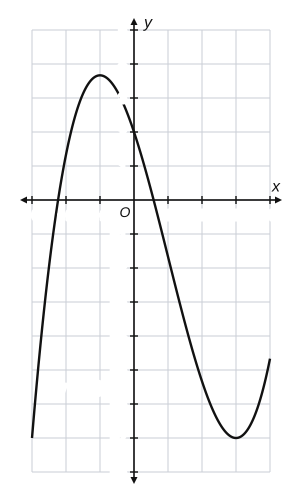
The graph of a function f is shown. On which interval is f both decreasing and concave up?
AA. (−1,1)
BB. (1,3)
CC. (3,4)
DD. (−1,3)
Antwort und Erklärung anzeigen
Richtige Antwort: B. (1,3)
Erklärung
The graph falls between its local maximum at x = −1 and its local minimum at x = 3. It bends downward (concave down) until the inflection point at x = 1 and upward afterwards. Decreasing AND concave up therefore happens only on (1, 3). (−1, 1) is decreasing but concave down, and (3, 4) is concave up but increasing.