examARnow Guías

British Council · IDP · Cambridge University Press & Assessment · Internacional

IELTS Academic: qué es y cómo prepararlo

Examen de inglés para estudiar o trabajar en el extranjero. Cuatro destrezas: Listening, Reading, Writing y Speaking; nota por bandas de 0 a 9.

2 h 44 min4 secciones97 preguntasNota 0–9
Practicar gratisGratis. Puedes empezar sin cuenta. Preguntas originales con explicación.

Estructura oficial

Estructura oficial: IELTS Academic
SecciónTiempoPreguntasNotaFormato
Listening30 min40Banda 0–94 grabaciones que se oyen UNA sola vez, 10 preguntas cada una. Parte 1: conversación cotidiana (p. ej., una reserva). Parte 2: monólogo cotidiano (p. ej., una visita guiada). Parte 3: conversación académica entre 2–4 personas. Parte 4: clase o conferencia. En papel hay 10 minutos extra para pasar respuestas; en ordenador, unos 2 minutos de repaso. Aquí el audio lo lee la voz del navegador y los planos se muestran como tablas.
Reading1 h40Banda 0–93 textos largos (2.150–2.750 palabras en total) de libros, revistas y periódicos, para público no especialista, de dificultad creciente. 40 preguntas de distintos tipos. No hay tiempo extra para pasar respuestas. El reparto 13/13/14 por texto es el habitual, pero puede variar.
Writing1 h2Banda 0–9Task 1: informe de al menos 150 palabras sobre un gráfico, tabla, diagrama o proceso (≈20 min). Task 2: ensayo de al menos 250 palabras sobre un tema general (≈40 min); cuenta el doble que Task 1. Se evalúan 4 criterios: Task Achievement/Response, Coherence and Cohesion, Lexical Resource y Grammatical Range and Accuracy. Aquí los datos visuales se dan como tabla o como figura, según el test.
Speaking14 min15Banda 0–9Entrevista cara a cara con un examinador (11–14 min, grabada). Parte 1 (4–5 min): preguntas sobre temas cotidianos. Parte 2 (3–4 min): tarjeta con un tema, 1 minuto para preparar y hasta 2 minutos hablando. Parte 3 (4–5 min): debate más abstracto sobre el tema de la Parte 2. El número de preguntas varía; las cifras de aquí son aproximadas. En la app la pregunta la lee la voz del navegador y tú grabas tu respuesta.

Puntuación

Cada destreza recibe una banda de 0 a 9 (en medias bandas). La nota global es la media de las cuatro redondeada a la media banda más cercana (.25 sube a .5 y .75 sube a la banda entera). En Listening y Reading la banda sale de los aciertos sobre 40 con una tabla de conversión que varía ligeramente entre versiones (ielts.org solo publica los aciertos medios de las bandas 5 a 8): aquí se muestra una ESTIMACIÓN basada en esos valores. Writing y Speaking los corrigen examinadores con cuatro criterios; aquí te autoevalúas con ellos.

Secciones y destrezas

Cada destreza tiene una guía con teoría breve y preguntas de ejemplo resueltas.

Listening

Comprender ideas principales, datos concretos, opiniones y el propósito de lo que se dice en conversaciones y monólogos.

Módulos: Part 1 (10 · 7.5 min) · Part 2 (10 · 7.5 min) · Part 3 (10 · 7.5 min) · Part 4 (10 · 7.5 min)

Question types · Varía en cada examen

Reading

Leer textos académicos largos: idea general, ideas principales, detalles, opiniones del autor y argumentación.

Módulos: Passage 1 (13 · 20 min) · Passage 2 (13 · 20 min) · Passage 3 (14 · 20 min)

Question types · Varía en cada examen

Writing

Describir datos visuales con precisión (Task 1) y argumentar por escrito (Task 2).

Módulos: Task 1 (1 · 20 min) · Task 2 (1 · 40 min)

Tasks · Task 2 pesa el doble que Task 1

Speaking

Hablar con fluidez y coherencia, con vocabulario y gramática variados y una pronunciación clara.

Módulos: Part 1 – Interview (9 · 5 min) · Part 2 – Long turn (1 · 4 min) · Part 3 – Discussion (5 · 5 min)

Test parts · 4 criterios, 25 % cada uno

Consejos para preparar el examen

Preguntas de ejemplo

Intenta responder antes de abrir la solución. Las preguntas están en el idioma del examen.

Pregunta 1

Dificultad: fácil≈ 1 min
Plan of Millbrook Community Garden (north is at the top; the main gate is in the middle of the south side)
West sideCentreEast side
NorthAGreenhouseB
MiddleCPondD
SouthEPath from main gateF
Transcripción del audio (en la app lo escuchas con voz)

Narrator: Part 2. You will hear a volunteer giving a talk to visitors at a community garden open day.

Guide: Good morning, everyone, and welcome to the Millbrook Community Garden open day. My name's Helen, and I've been a volunteer here for six years. Before you explore, I'll give you a quick idea of where everything is. Please look at the plan in your leaflet.

Guide: Just a couple of practical points first. The toilets are in the small brick building just outside the gate, next to the bike racks, and they're accessible for wheelchair users. Most of the paths inside the garden are wide and flat, although the ones around the pond can be a bit muddy after rain, so do take care there. And if you have small children with you, please keep an eye on them near the water – the pond is deeper than it looks. We've also got free tea and homemade cakes in the marquee by the gate all day, made by our volunteers.

Guide: We're standing at the main gate, on the south side of the garden. As you come in through the gate, the first thing on your right is the herb garden. It's lovely at this time of year, so do take a moment to smell the plants. Directly opposite the herb garden, on the other side of the path, you'll see the tool shed. That's where volunteers collect everything they need at the start of a session.

Guide: If you walk straight ahead from the gate, you'll come to the pond, which is right in the middle of the garden. To the left of the pond, as you face it, is the children's garden, where local schools grow their own vegetables. People sometimes expect the beehives to be up near the greenhouse, but in fact we keep them on the east side of the pond, well away from the children's area.

Guide: The greenhouse is at the northern end of the garden, in the centre. And the compost area is in the far corner, beyond the greenhouse on the right-hand side. It's a long way from the gate, but that's deliberate, because it can get a bit smelly in summer! The space in the opposite corner, on the left of the greenhouse, is empty at the moment, but we're hoping to turn it into a wildflower meadow next year.

Guide: Now, a little about our history. A lot of visitors assume the garden was once part of the old factory next door, but actually the land was a car park until about twelve years ago. When the council decided it wasn't needed, a group of neighbours asked if they could use it, and we've been here ever since.

Guide: We're always looking for new volunteers. We have plenty of people at weekends, but where we're really short is on weekday mornings, when there's watering and weeding to be done. Even an hour a week makes a difference.

Guide: People often ask what happens to the vegetables. We did try running a market stall once, but it took up too much time. Volunteers are welcome to take a little home, but most of what we grow goes to the food bank on the high street.

Guide: If you'd like to join us, it couldn't be simpler. There's no membership fee, and we lend all the tools, so you don't need to buy anything. You don't even have to fill in a form online. Just come along any Saturday morning, and the first thing you'll do is a short safety talk with one of our team leaders.

Guide: Finally, a change to today's programme. The beekeeping demonstration was going to take place outside by the hives at three o'clock. We're expecting quite a crowd, which is great, but that isn't the problem: the forecast says heavy rain this afternoon, so we've moved it into the greenhouse. The time hasn't changed. Right, enjoy your visit!

Questions 16–20. Choose the correct letter, A, B or C.

16. Before it became a garden, the site was

  1. A. part of a factory.
  2. B. a car park.
  3. C. a school playing field.
Ver respuesta y explicación

Respuesta correcta: B. a car park.

Explicación

B. 'A lot of visitors assume the garden was once part of the old factory next door, but actually the land was a car park.' A is the common mistake the speaker corrects; C is never mentioned.
Pregunta 2

Dificultad: fácil≈ 1 min

Reading Passage 1 – Under the Canopy: A Short History of the Umbrella

A The umbrella is one of the oldest portable objects still in daily use, yet for most of its history it had nothing to do with rain. In ancient Egypt, Assyria and China, the earliest umbrellas were parasols: large shades carried by servants to protect kings, priests and nobles from the sun. Being shaded was a sign of rank, and in some kingdoms only the ruler was permitted to stand beneath certain kinds of canopy. Carvings on palace walls show attendants holding the shade at a respectful distance behind their masters, and the number of canopies that accompanied a procession told onlookers exactly how important its leader was.

B The Chinese are generally credited with making the first umbrellas that could keep out water. By the fourth century, craftsmen were coating paper canopies with wax and lacquer, and later versions used oiled silk stretched over a frame of bamboo. These umbrellas could be opened and closed, and they gradually came to be used by ordinary people as well as officials, although elaborate colours and decorations remained a privilege of the wealthy. The idea travelled east to Korea and Japan, where makers developed their own styles of paper umbrella, and in some places the craft was handed down within families for generations.

C In Europe, sunshades were known to the Greeks and Romans, but the habit largely disappeared after the fall of Rome. It returned in the sixteenth and seventeenth centuries, first in Italy and France, where fashionable women carried small parasols. Men were slower to adopt the idea. When the English traveller Jonas Hanway began carrying an umbrella through the streets of London in the 1750s, he was reportedly jeered at by passers-by, and the drivers of horse-drawn carriages, whose income depended partly on wet pedestrians hiring their vehicles, are said to have been particularly hostile.

D Part of the resistance was practical. Early European umbrellas were bulky objects, with canopies of oiled canvas or waxed cotton and frames of wood or whalebone, and they were heavy to carry and slow to dry. Because they were so awkward, they were often kept in a shared place rather than carried: coffee houses and churches are recorded as keeping large umbrellas to lend to people caught in a shower. Only when makers found ways to reduce the weight did owning a personal umbrella begin to seem sensible.

E Attitudes changed quickly, however. By the end of the eighteenth century the umbrella had become an accepted part of a gentleman’s equipment in Britain, and its manufacture expanded rapidly in the nineteenth century. In 1852 the English manufacturer Samuel Fox introduced a frame made of thin steel ribs with a U-shaped cross-section. This design was lighter and much stronger than the whalebone and wooden frames used before, and versions of it are still used in most umbrellas today. Because steel was cheap and easy to mass-produce, the price of an umbrella fell steadily, and by the end of the century it was no longer a luxury but an item that most families could afford.

F Later improvements concerned convenience rather than the basic structure. Folding umbrellas, small enough to fit into a bag, were patented in the twentieth century, and automatic models that open at the press of a button followed. Yet the fundamental arrangement of a central shaft, a set of hinged ribs and a fabric canopy would have been recognisable to an umbrella maker of two hundred years ago.

G The umbrella has also acquired meanings beyond its practical use. In parts of Asia, decorated umbrellas still appear in weddings and religious festivals, where they are associated with protection and good fortune, and some temples keep ceremonial umbrellas that are far larger than anything intended for the rain. In Europe and North America, by contrast, the umbrella has become a cheap, mass-produced item that people buy without a second thought and replace after a single storm.

H Despite its long history, the umbrella has well-known weaknesses. It occupies one hand, it can be turned inside out by strong winds, and it is one of the items most frequently left behind on public transport. Designers continue to experiment with wind-resistant shapes and hands-free versions, but none has replaced the traditional design, which suggests that the perfect umbrella may still be waiting to be invented.

Questions 1–7. Reading Passage 1 has eight paragraphs, A–H. Which paragraph contains the following information?

2. a reference to the role of umbrellas in ceremonies

  1. A. A
  2. B. B
  3. C. C
  4. D. D
  5. E. E
  6. F. F
  7. G. G
  8. H. H
Ver respuesta y explicación

Respuesta correcta: G. G

Explicación

Paragraph G: in parts of Asia, decorated umbrellas “still appear in weddings and religious festivals.”

Pregunta 3

Dificultad: media≈ 20 min
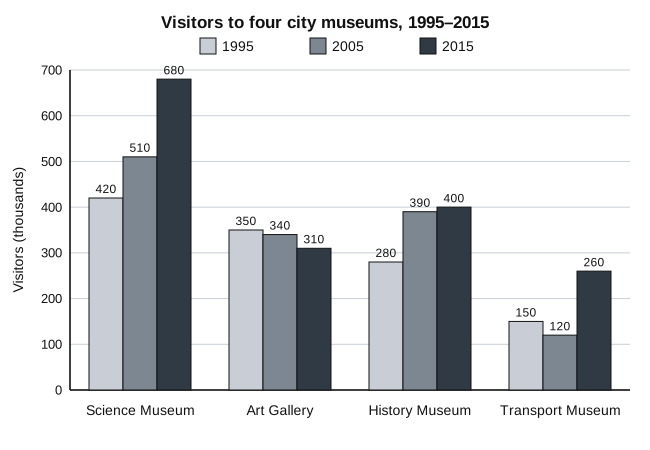
Bar chart of visitors to four city museums, in thousands. Science Museum: 420 in 1995, 510 in 2005, 680 in 2015. Art Gallery: 350, 340, 310. History Museum: 280, 390, 400. Transport Museum: 150, 120, 260.

Writing Task 1. You should spend about 20 minutes on this task.

The bar chart below shows the number of visitors to four museums in one city in 1995, 2005 and 2015.

Summarise the information by selecting and reporting the main features, and make comparisons where relevant.

Write at least 150 words.

150–220 palabras · 20 min.

Ver solución modelo y criterios

Respuesta modelo

The bar chart illustrates how many people visited four museums in one city in 1995, 2005 and 2015.

Overall, total visitor numbers rose over the period, and the Science Museum was the most popular attraction in all three years. The Art Gallery was the only museum whose attendance fell over the twenty years as a whole.

The Science Museum saw the largest growth, with visitors increasing from 420,000 in 1995 to 510,000 in 2005 and then to 680,000 in 2015. The History Museum also became more popular, rising from 280,000 to 390,000 in the first decade, although it gained only a further 10,000 visitors in the second.

The other two museums followed different patterns. The Art Gallery attracted 350,000 visitors in 1995, but this figure declined slightly to 340,000 and then to 310,000. The Transport Museum, the least visited of the four in every year, dipped from 150,000 to 120,000 in 2005 before more than doubling to 260,000 in 2015.

As a result, the combined number of visitors to the four museums grew from 1.2 million to 1.65 million.

Criterios de corrección

  • Task Achievement: covers the requirements; gives a clear overview of the main trends or differences; highlights and illustrates key features with accurate figures; reports only what the data show (no opinions or causes)
  • Coherence and Cohesion: organises information logically (introduction, overview, 2 body paragraphs); uses a range of linking devices accurately; clear paragraphing
  • Lexical Resource: varied, precise vocabulary for describing and comparing data (rose, declined slightly, more than doubled, the proportion of...); accurate spelling and word formation
  • Grammatical Range and Accuracy: mix of simple and complex sentences (comparatives, relative clauses, while/whereas); most sentences error-free
  • Length and time: at least 150 words in about 20 minutes; do not copy the wording of the task

Explicación

With a bar chart over several years, describe trends (rose, dipped, more than doubled) rather than isolated numbers, and remember the figures are in thousands (420 = 420,000). A good overview mentions the overall increase, the leader (Science Museum) and the exception (Art Gallery). Grouping rising museums in one paragraph and the others in another keeps the report coherent.

Pregunta 4

Dificultad: fácil≈ 1 min
Transcripción del audio (en la app lo escuchas con voz)

Examiner: Now let's talk about reading. Do you enjoy reading?

Speaking Part 1 (introduction and interview). The examiner asks you questions about familiar topics. Answer naturally in 2–3 sentences: give a direct answer, then a reason or example.

Tiempo para responder: 30 s.

Ver solución modelo y criterios

Respuesta modelo

Yes, I do, although I don't have as much time for it as I'd like. I usually read for about half an hour before bed, which helps me switch off after a long day.

Criterios de corrección

  • Fluency and Coherence: speaks at length without noticeable effort; ideas are linked logically with a range of connectives and discourse markers
  • Lexical Resource: flexible, precise vocabulary, including some less common and idiomatic items; paraphrases when needed
  • Grammatical Range and Accuracy: a mix of simple and complex structures; most sentences are error-free
  • Pronunciation: easy to understand throughout; uses stress, rhythm and intonation to convey meaning

Explicación

A simple yes/no question still needs extension: add how often, when or why. Phrases like 'although' and 'which helps me' show natural linking.

Preguntas frecuentes

¿Cuánto dura el examen IELTS?

2 h 44 min en total. Secciones: Listening (30 min), Reading (1 h), Writing (1 h), Speaking (14 min).

¿Cómo se puntúa el examen IELTS?

Escala global 0–9. Cada destreza recibe una banda de 0 a 9 (en medias bandas). La nota global es la media de las cuatro redondeada a la media banda más cercana (.25 sube a .5 y .75 sube a la banda entera). En Listening y Reading la banda sale de los aciertos sobre 40 con una tabla de conversión que varía ligeramente entre versiones (ielts.org solo publica los aciertos medios de las bandas 5 a 8): aquí se muestra una ESTIMACIÓN basada en esos valores. Writing y Speaking los corrigen examinadores con cuatro criterios; aquí te autoevalúas con ellos.

¿Las preguntas de examARnow son oficiales?

No. Son preguntas originales que siguen el formato publicado por British Council · IDP · Cambridge University Press & Assessment, revisadas una a una. examARnow no está afiliado a British Council · IDP · Cambridge University Press & Assessment.

¿Es gratis practicar IELTS en examARnow?

Sí. Puedes empezar sin cuenta; tras unos ejercicios te propondrá crear una cuenta gratuita para guardar tu progreso.

¿Cuántas preguntas de práctica de IELTS hay?

382 preguntas originales revisadas, repartidas en 21 destrezas.

Fuentes

Qué hemos verificado: Verificado con búsquedas que citan ielts.org, British Council y Cambridge (no se pudieron abrir las páginas directamente): Listening 4 partes, 40 preguntas, unos 30 min (+10 min para pasar respuestas solo en papel; en ordenador unos 2 min de repaso); Reading 3 textos, 40 preguntas, 60 min, 2.150–2.750 palabras en total; Writing 60 min, Task 1 ≥150 palabras (≈20 min) y Task 2 ≥250 (≈40 min), Task 2 pesa el doble; Speaking 11–14 min en 3 partes; bandas 0–9 y regla de redondeo de la nota global; One Skill Retake (solo en ordenador, repetir una destreza en un plazo de 60 días, según el país). Fuentes secundarias (The PIE News y otras) indican que el examen en papel termina en la mayoría de países el 27/06/2026 y que el contenido del examen no cambia: no lo he podido confirmar en ielts.org. NO verificado: la tabla oficial de aciertos→banda (no es pública), la disponibilidad exacta de One Skill Retake por país y los minutos de cada parte de Speaking (4–5 / 3–4 / 4–5 según fuentes de preparación).

Practicar gratisGratis. Puedes empezar sin cuenta. Preguntas originales con explicación.