examARnow Guides

British Council · IDP · Cambridge University Press & Assessment · International

IELTS Academic: format, scoring and free practice

English test for study or work abroad. Four skills – Listening, Reading, Writing and Speaking – scored in bands from 0 to 9.

2 h 44 min4 sections97 questionsScore 0–9
Practise for freeFree. You can start without an account. Original questions with explanations.

Official format

Official format: IELTS Academic
SectionTimeQuestionsScoreFormat
Listening30 min40Band 0–94 recordings heard ONCE only, 10 questions each. Part 1: everyday conversation (e.g. a booking). Part 2: everyday monologue (e.g. a guided tour). Part 3: academic conversation between 2–4 people. Part 4: a lecture. Paper tests add 10 minutes to transfer answers; computer tests give about 2 minutes to check. Here the audio is read by the browser's voice and plans are shown as tables.
Reading1 h40Band 0–93 long texts (2,150–2,750 words in total) from books, journals and newspapers, written for a non-specialist audience, in increasing difficulty. 40 questions of various types. There is no extra transfer time. The 13/13/14 split per passage is typical but can vary.
Writing1 h2Band 0–9Task 1: a report of at least 150 words on a graph, table, chart, diagram or process (≈20 min). Task 2: an essay of at least 250 words on a general topic (≈40 min); it counts twice as much as Task 1. Four criteria: Task Achievement/Response, Coherence and Cohesion, Lexical Resource, and Grammatical Range and Accuracy. Here visual data are given as a table or a figure, depending on the test.
Speaking14 min15Band 0–9Face-to-face interview with an examiner (11–14 min, recorded). Part 1 (4–5 min): questions on familiar topics. Part 2 (3–4 min): a task card, 1 minute to prepare and up to 2 minutes speaking. Part 3 (4–5 min): a more abstract discussion linked to Part 2. The number of questions varies; the figures here are approximate. In the app the browser's voice reads the question and you record your answer.

Scoring

Each skill gets a band from 0 to 9 (in half bands). The overall band is the mean of the four, rounded to the nearest half band (.25 rounds up to .5 and .75 up to the next whole band). Listening and Reading bands come from the number of correct answers out of 40 using a conversion table that varies slightly between versions (ielts.org publishes only the average raw scores for bands 5 to 8), so the platform shows an ESTIMATE based on those figures. Writing and Speaking are marked by examiners on four criteria; here you self-assess with them.

Sections and skills

Each skill has a guide with short theory and worked sample questions.

Listening

Understanding main ideas, specific facts, opinions and speakers' purpose in conversations and monologues.

Modules: Part 1 (10 · 7.5 min) · Part 2 (10 · 7.5 min) · Part 3 (10 · 7.5 min) · Part 4 (10 · 7.5 min)

Question types · Varies from test to test

Reading

Reading long academic texts: gist, main ideas, detail, the writer's views and line of argument.

Modules: Passage 1 (13 · 20 min) · Passage 2 (13 · 20 min) · Passage 3 (14 · 20 min)

Question types · Varies from test to test

Writing

Describing visual data accurately (Task 1) and writing an argument (Task 2).

Modules: Task 1 (1 · 20 min) · Task 2 (1 · 40 min)

Tasks · Task 2 carries twice the weight of Task 1

Speaking

Speaking fluently and coherently, with varied vocabulary and grammar and clear pronunciation.

Modules: Part 1 – Interview (9 · 5 min) · Part 2 – Long turn (1 · 4 min) · Part 3 – Discussion (5 · 5 min)

Test parts · 4 criteria, 25% each

Tips for the exam

Sample questions

Try to answer before opening the solution.

Question 1

Difficulty: easy≈ 1 min
Plan of Millbrook Community Garden (north is at the top; the main gate is in the middle of the south side)
West sideCentreEast side
NorthAGreenhouseB
MiddleCPondD
SouthEPath from main gateF
Audio transcript (in the app you hear it read aloud)

Narrator: Part 2. You will hear a volunteer giving a talk to visitors at a community garden open day.

Guide: Good morning, everyone, and welcome to the Millbrook Community Garden open day. My name's Helen, and I've been a volunteer here for six years. Before you explore, I'll give you a quick idea of where everything is. Please look at the plan in your leaflet.

Guide: Just a couple of practical points first. The toilets are in the small brick building just outside the gate, next to the bike racks, and they're accessible for wheelchair users. Most of the paths inside the garden are wide and flat, although the ones around the pond can be a bit muddy after rain, so do take care there. And if you have small children with you, please keep an eye on them near the water – the pond is deeper than it looks. We've also got free tea and homemade cakes in the marquee by the gate all day, made by our volunteers.

Guide: We're standing at the main gate, on the south side of the garden. As you come in through the gate, the first thing on your right is the herb garden. It's lovely at this time of year, so do take a moment to smell the plants. Directly opposite the herb garden, on the other side of the path, you'll see the tool shed. That's where volunteers collect everything they need at the start of a session.

Guide: If you walk straight ahead from the gate, you'll come to the pond, which is right in the middle of the garden. To the left of the pond, as you face it, is the children's garden, where local schools grow their own vegetables. People sometimes expect the beehives to be up near the greenhouse, but in fact we keep them on the east side of the pond, well away from the children's area.

Guide: The greenhouse is at the northern end of the garden, in the centre. And the compost area is in the far corner, beyond the greenhouse on the right-hand side. It's a long way from the gate, but that's deliberate, because it can get a bit smelly in summer! The space in the opposite corner, on the left of the greenhouse, is empty at the moment, but we're hoping to turn it into a wildflower meadow next year.

Guide: Now, a little about our history. A lot of visitors assume the garden was once part of the old factory next door, but actually the land was a car park until about twelve years ago. When the council decided it wasn't needed, a group of neighbours asked if they could use it, and we've been here ever since.

Guide: We're always looking for new volunteers. We have plenty of people at weekends, but where we're really short is on weekday mornings, when there's watering and weeding to be done. Even an hour a week makes a difference.

Guide: People often ask what happens to the vegetables. We did try running a market stall once, but it took up too much time. Volunteers are welcome to take a little home, but most of what we grow goes to the food bank on the high street.

Guide: If you'd like to join us, it couldn't be simpler. There's no membership fee, and we lend all the tools, so you don't need to buy anything. You don't even have to fill in a form online. Just come along any Saturday morning, and the first thing you'll do is a short safety talk with one of our team leaders.

Guide: Finally, a change to today's programme. The beekeeping demonstration was going to take place outside by the hives at three o'clock. We're expecting quite a crowd, which is great, but that isn't the problem: the forecast says heavy rain this afternoon, so we've moved it into the greenhouse. The time hasn't changed. Right, enjoy your visit!

Questions 16–20. Choose the correct letter, A, B or C.

16. Before it became a garden, the site was

  1. A. part of a factory.
  2. B. a car park.
  3. C. a school playing field.
Show answer and explanation

Correct answer: B. a car park.

Explanation

B. 'A lot of visitors assume the garden was once part of the old factory next door, but actually the land was a car park.' A is the common mistake the speaker corrects; C is never mentioned.
Question 2

Difficulty: easy≈ 1 min

Reading Passage 1 – Under the Canopy: A Short History of the Umbrella

A The umbrella is one of the oldest portable objects still in daily use, yet for most of its history it had nothing to do with rain. In ancient Egypt, Assyria and China, the earliest umbrellas were parasols: large shades carried by servants to protect kings, priests and nobles from the sun. Being shaded was a sign of rank, and in some kingdoms only the ruler was permitted to stand beneath certain kinds of canopy. Carvings on palace walls show attendants holding the shade at a respectful distance behind their masters, and the number of canopies that accompanied a procession told onlookers exactly how important its leader was.

B The Chinese are generally credited with making the first umbrellas that could keep out water. By the fourth century, craftsmen were coating paper canopies with wax and lacquer, and later versions used oiled silk stretched over a frame of bamboo. These umbrellas could be opened and closed, and they gradually came to be used by ordinary people as well as officials, although elaborate colours and decorations remained a privilege of the wealthy. The idea travelled east to Korea and Japan, where makers developed their own styles of paper umbrella, and in some places the craft was handed down within families for generations.

C In Europe, sunshades were known to the Greeks and Romans, but the habit largely disappeared after the fall of Rome. It returned in the sixteenth and seventeenth centuries, first in Italy and France, where fashionable women carried small parasols. Men were slower to adopt the idea. When the English traveller Jonas Hanway began carrying an umbrella through the streets of London in the 1750s, he was reportedly jeered at by passers-by, and the drivers of horse-drawn carriages, whose income depended partly on wet pedestrians hiring their vehicles, are said to have been particularly hostile.

D Part of the resistance was practical. Early European umbrellas were bulky objects, with canopies of oiled canvas or waxed cotton and frames of wood or whalebone, and they were heavy to carry and slow to dry. Because they were so awkward, they were often kept in a shared place rather than carried: coffee houses and churches are recorded as keeping large umbrellas to lend to people caught in a shower. Only when makers found ways to reduce the weight did owning a personal umbrella begin to seem sensible.

E Attitudes changed quickly, however. By the end of the eighteenth century the umbrella had become an accepted part of a gentleman’s equipment in Britain, and its manufacture expanded rapidly in the nineteenth century. In 1852 the English manufacturer Samuel Fox introduced a frame made of thin steel ribs with a U-shaped cross-section. This design was lighter and much stronger than the whalebone and wooden frames used before, and versions of it are still used in most umbrellas today. Because steel was cheap and easy to mass-produce, the price of an umbrella fell steadily, and by the end of the century it was no longer a luxury but an item that most families could afford.

F Later improvements concerned convenience rather than the basic structure. Folding umbrellas, small enough to fit into a bag, were patented in the twentieth century, and automatic models that open at the press of a button followed. Yet the fundamental arrangement of a central shaft, a set of hinged ribs and a fabric canopy would have been recognisable to an umbrella maker of two hundred years ago.

G The umbrella has also acquired meanings beyond its practical use. In parts of Asia, decorated umbrellas still appear in weddings and religious festivals, where they are associated with protection and good fortune, and some temples keep ceremonial umbrellas that are far larger than anything intended for the rain. In Europe and North America, by contrast, the umbrella has become a cheap, mass-produced item that people buy without a second thought and replace after a single storm.

H Despite its long history, the umbrella has well-known weaknesses. It occupies one hand, it can be turned inside out by strong winds, and it is one of the items most frequently left behind on public transport. Designers continue to experiment with wind-resistant shapes and hands-free versions, but none has replaced the traditional design, which suggests that the perfect umbrella may still be waiting to be invented.

Questions 1–7. Reading Passage 1 has eight paragraphs, A–H. Which paragraph contains the following information?

2. a reference to the role of umbrellas in ceremonies

  1. A. A
  2. B. B
  3. C. C
  4. D. D
  5. E. E
  6. F. F
  7. G. G
  8. H. H
Show answer and explanation

Correct answer: G. G

Explanation

Paragraph G: in parts of Asia, decorated umbrellas “still appear in weddings and religious festivals.”

Question 3

Difficulty: medium≈ 20 min
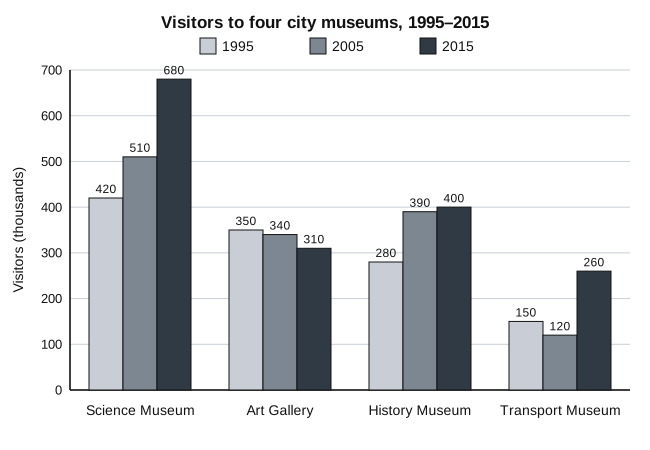
Bar chart of visitors to four city museums, in thousands. Science Museum: 420 in 1995, 510 in 2005, 680 in 2015. Art Gallery: 350, 340, 310. History Museum: 280, 390, 400. Transport Museum: 150, 120, 260.

Writing Task 1. You should spend about 20 minutes on this task.

The bar chart below shows the number of visitors to four museums in one city in 1995, 2005 and 2015.

Summarise the information by selecting and reporting the main features, and make comparisons where relevant.

Write at least 150 words.

150–220 words · 20 min.

Show model answer and criteria

Model answer

The bar chart illustrates how many people visited four museums in one city in 1995, 2005 and 2015.

Overall, total visitor numbers rose over the period, and the Science Museum was the most popular attraction in all three years. The Art Gallery was the only museum whose attendance fell over the twenty years as a whole.

The Science Museum saw the largest growth, with visitors increasing from 420,000 in 1995 to 510,000 in 2005 and then to 680,000 in 2015. The History Museum also became more popular, rising from 280,000 to 390,000 in the first decade, although it gained only a further 10,000 visitors in the second.

The other two museums followed different patterns. The Art Gallery attracted 350,000 visitors in 1995, but this figure declined slightly to 340,000 and then to 310,000. The Transport Museum, the least visited of the four in every year, dipped from 150,000 to 120,000 in 2005 before more than doubling to 260,000 in 2015.

As a result, the combined number of visitors to the four museums grew from 1.2 million to 1.65 million.

Marking criteria

  • Task Achievement: covers the requirements; gives a clear overview of the main trends or differences; highlights and illustrates key features with accurate figures; reports only what the data show (no opinions or causes)
  • Coherence and Cohesion: organises information logically (introduction, overview, 2 body paragraphs); uses a range of linking devices accurately; clear paragraphing
  • Lexical Resource: varied, precise vocabulary for describing and comparing data (rose, declined slightly, more than doubled, the proportion of...); accurate spelling and word formation
  • Grammatical Range and Accuracy: mix of simple and complex sentences (comparatives, relative clauses, while/whereas); most sentences error-free
  • Length and time: at least 150 words in about 20 minutes; do not copy the wording of the task

Explanation

With a bar chart over several years, describe trends (rose, dipped, more than doubled) rather than isolated numbers, and remember the figures are in thousands (420 = 420,000). A good overview mentions the overall increase, the leader (Science Museum) and the exception (Art Gallery). Grouping rising museums in one paragraph and the others in another keeps the report coherent.

Question 4

Difficulty: easy≈ 1 min
Audio transcript (in the app you hear it read aloud)

Examiner: Now let's talk about reading. Do you enjoy reading?

Speaking Part 1 (introduction and interview). The examiner asks you questions about familiar topics. Answer naturally in 2–3 sentences: give a direct answer, then a reason or example.

Time to answer: 30 s.

Show model answer and criteria

Model answer

Yes, I do, although I don't have as much time for it as I'd like. I usually read for about half an hour before bed, which helps me switch off after a long day.

Marking criteria

  • Fluency and Coherence: speaks at length without noticeable effort; ideas are linked logically with a range of connectives and discourse markers
  • Lexical Resource: flexible, precise vocabulary, including some less common and idiomatic items; paraphrases when needed
  • Grammatical Range and Accuracy: a mix of simple and complex structures; most sentences are error-free
  • Pronunciation: easy to understand throughout; uses stress, rhythm and intonation to convey meaning

Explanation

A simple yes/no question still needs extension: add how often, when or why. Phrases like 'although' and 'which helps me' show natural linking.

Frequently asked questions

How long is the IELTS exam?

2 h 44 min in total. Sections: Listening (30 min), Reading (1 h), Writing (1 h), Speaking (14 min).

How is the IELTS scored?

Overall scale 0–9. Each skill gets a band from 0 to 9 (in half bands). The overall band is the mean of the four, rounded to the nearest half band (.25 rounds up to .5 and .75 up to the next whole band). Listening and Reading bands come from the number of correct answers out of 40 using a conversion table that varies slightly between versions (ielts.org publishes only the average raw scores for bands 5 to 8), so the platform shows an ESTIMATE based on those figures. Writing and Speaking are marked by examiners on four criteria; here you self-assess with them.

Are the examARnow questions official?

No. They are original questions that follow the format published by British Council · IDP · Cambridge University Press & Assessment, each one reviewed. examARnow is not affiliated with British Council · IDP · Cambridge University Press & Assessment.

Is IELTS practice on examARnow free?

Yes. You can start without an account; after a few exercises it suggests creating a free account to save your progress.

How many IELTS practice questions are there?

382 reviewed original questions across 21 skills.

Sources

What we checked: Checked through web searches citing ielts.org, the British Council and Cambridge (the pages themselves could not be opened): Listening 4 parts, 40 questions, about 30 min (+10 min transfer time on paper only; about 2 min review on computer); Reading 3 texts, 40 questions, 60 min, 2,150–2,750 words in total; Writing 60 min, Task 1 ≥150 words (≈20 min) and Task 2 ≥250 words (≈40 min), Task 2 worth twice as much; Speaking 11–14 min in 3 parts; 0–9 bands and the overall rounding rule; One Skill Retake (computer-delivered only, one skill retaken within 60 days, depending on country). Secondary sources (The PIE News and others) report that paper-based IELTS ends in most countries on 27 June 2026 with no change to test content; I could not confirm this on ielts.org. NOT verified: the official raw-score-to-band tables (not published), exact One Skill Retake availability by country, and the exact minutes of each Speaking part (4–5 / 3–4 / 4–5 according to preparation sources).

Practise for freeFree. You can start without an account. Original questions with explanations.