Entscheiden, ob Daten eine Hypothese oder Schlussfolgerung stützen.
Das Wichtigste
Bei „Yes/No, because…“ muss der Grund wahr UND relevant sein.
Strategie Schritt für Schritt
Entscheide zuerst anhand der Daten, ob ja oder nein; wähle dann den Grund.
Typische Fallen
Wahre Gründe, die sich auf ein anderes Experiment beziehen.
Gelöstes Beispiel
Hypothese zum pH bei 30°C → sieh dir Experiment 2 (30°C) an, nicht 1.
Beispielfragen
Versuche zu antworten, bevor du die Lösung öffnest. Die Fragen sind in der Prüfungssprache.
Frage 1
Schwierigkeit: mittel≈ 1 min
Passage VI — Wrapping and cooling (data representation)
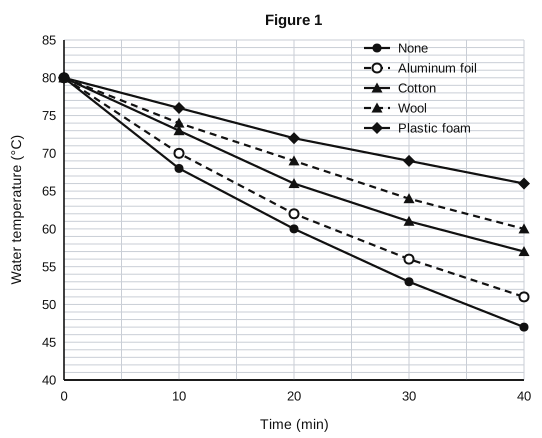
Students tested how well different materials slow the cooling of hot water. They filled 5 identical metal cans with 400 mL of water at 80°C. One can was left unwrapped. Each of the other cans was wrapped in a different material: aluminum foil (a single layer), or a 1.0 cm thick layer of cotton, wool, or plastic foam. The cans were placed on a wooden table in a room kept at 21°C, and the water temperature in each can was recorded every 10 minutes for 40 minutes. The results are shown in Figure 1.
A student concluded that, under the conditions of the study, wool slowed cooling more than cotton did. Do the results support this conclusion?
AA. Yes, because the wool can was warmer than the cotton can at every time after 0 min.
BB. Yes, because wool and cotton were both wrapped in 1.0 cm layers.
CC. No, because the water in the cotton can was warmer than that in the wool can at 40 min.
DD. No, because plastic foam slowed cooling more than either wool or cotton did.
Antwort und Erklärung anzeigen
Richtige Antwort: A. Yes, because the wool can was warmer than the cotton can at every time after 0 min.
Erklärung
At 10, 20, 30, and 40 min, the wool can was at about 74, 69, 64, and 60°C, while the cotton can was at about 73, 66, 61, and 57°C. The wool line is always above the cotton line, so wool slowed cooling more.
Equal thickness makes the comparison fair, but it is not evidence of which material worked better. At 40 min the wool can (60°C) was warmer than the cotton can (57°C), so the third choice is false. Foam’s better performance does not change the comparison between wool and cotton.
Frage 2
Schwierigkeit: mittel≈ 1 min
Passage V — City noise and bird song (data representation)
Male songbirds sing to defend their territories and to attract mates. Traffic noise is mostly low-pitched, so it easily masks (drowns out) the low-pitched parts of a song.
Researchers studied a songbird species that lives in forests, suburbs, and city centers. For each of 12 males, they measured the background noise level in the male’s territory, in decibels (dB), and the lowest frequency in the male’s song, in kilohertz (kHz). A higher frequency is a higher pitch. Figure 1 shows the results, with a line of best fit. Figure 2 shows the average background noise in each of the 3 habitats at dawn and at noon.
A researcher hypothesized that males in noisier territories sing with a higher lowest frequency. Do the data in Figure 1 support this hypothesis?
AA. Yes; the males in the noisiest territories had the highest lowest frequencies.
BB. Yes; background noise was greater at noon than at dawn in every habitat.
CC. No; a male in a 60 dB territory had a lower frequency than a male in a 57 dB territory.
DD. No; the lowest frequency did not change as background noise changed.
Antwort und Erklärung anzeigen
Richtige Antwort: A. Yes; the males in the noisiest territories had the highest lowest frequencies.
Erklärung
The trend in Figure 1 is clearly upward: the quietest territories (about 42–47 dB) have frequencies near 2.7 kHz, and the noisiest (65–70 dB) have 3.3–3.5 kHz.
The noon/dawn comparison is about noise only, not song. One pair of points that goes against the trend does not cancel a strong overall pattern. The frequency did change, by almost 1 kHz.
Frage 3
Schwierigkeit: schwer≈ 1 min
Passage VII — Solubility of 3 salts (research summary)
The solubility of a substance is the greatest mass of it that can dissolve in a given amount of water at a given temperature. A solution that holds that greatest mass is saturated.
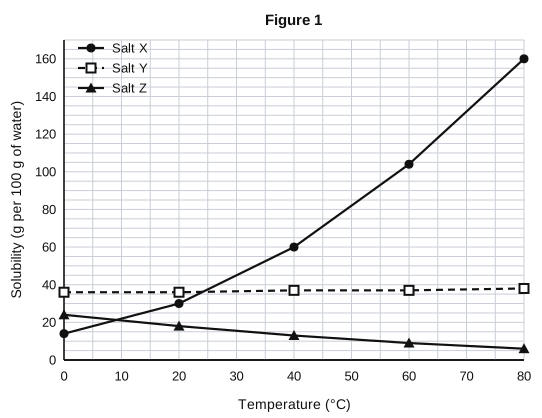
Students measured the solubility of 3 salts (Salts X, Y, and Z) in 100 g of water at 5 temperatures. At each temperature, they added a salt to the water in small portions, stirring for 5 minutes after each addition, until some of the salt remained undissolved. They then filtered the mixture, dried and weighed the undissolved salt, and subtracted that mass from the total mass of salt added. The results are shown in Figure 1.
A student predicted that cooling a saturated solution of Salt Z from 60°C to 20°C would cause solid Salt Z to form. Do the results support this prediction?
AA. Yes; the solubility of Salt Z at 20°C is less than its solubility at 60°C.
BB. Yes; the solubility of every salt increases as temperature increases.
CC. No; Salt Z is more soluble at 20°C than at 60°C, so all of it stays dissolved.
DD. No; Salt Z does not dissolve in water at 20°C.
Antwort und Erklärung anzeigen
Richtige Antwort: C. No; Salt Z is more soluble at 20°C than at 60°C, so all of it stays dissolved.
Erklärung
Salt Z is the one salt whose solubility DECREASES with temperature: 9 g at 60°C but 18 g at 20°C. The 9 g dissolved at 60°C easily stays dissolved at 20°C, so no solid forms.
The first choice reverses the data. Salt Z shows that not every salt becomes more soluble when heated. Salt Z dissolves at 20°C (18 g).