Variablen, Kontrollen, konstante Bedingungen und Planung eines Versuchs.
Das Wichtigste
Ein gutes Experiment ändert EINE Variable und hält den Rest konstant.
Kontrolle = wie die anderen Versuche, aber ohne den getesteten Faktor.
Strategie Schritt für Schritt
Liste auf, was sich in jedem Experiment ändert und was gleich bleibt.
Typische Fallen
Versuchsaufbauten, die zwei Variablen gleichzeitig verändern.
Gelöstes Beispiel
Does catalase produce the O₂? Ein Versuch mit Wasser statt Katalase.
Beispielfragen
Versuche zu antworten, bevor du die Lösung öffnest. Die Fragen sind in der Prüfungssprache.
Frage 1
Schwierigkeit: leicht≈ 1 min
Passage VI — Wrapping and cooling (data representation)
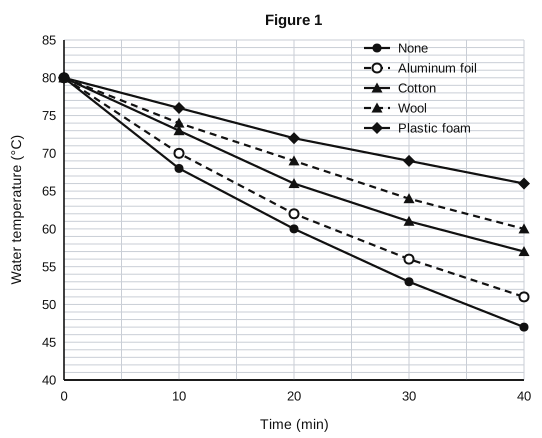
Students tested how well different materials slow the cooling of hot water. They filled 5 identical metal cans with 400 mL of water at 80°C. One can was left unwrapped. Each of the other cans was wrapped in a different material: aluminum foil (a single layer), or a 1.0 cm thick layer of cotton, wool, or plastic foam. The cans were placed on a wooden table in a room kept at 21°C, and the water temperature in each can was recorded every 10 minutes for 40 minutes. The results are shown in Figure 1.
The unwrapped can was most likely included in the study in order to:
AA. provide a baseline for judging how much each wrapping slowed cooling.
BB. measure the temperature of the room during the study.
CC. show that metal cans keep water hot longer than glass or plastic containers do.
DD. keep the water in the other cans from cooling below 21°C.
Antwort und Erklärung anzeigen
Richtige Antwort: A. provide a baseline for judging how much each wrapping slowed cooling.
Erklärung
The unwrapped can shows how fast the water cools with no insulation. Comparing each wrapped can with it shows how much each material helped, so it serves as the control.
The room temperature was kept at 21°C and was not measured with the can. Only metal cans were used, so containers were not compared. An unwrapped can cannot affect the cooling of the other cans.
Frage 2
Schwierigkeit: mittel≈ 1 min
Passage VII — Solubility of 3 salts (research summary)
The solubility of a substance is the greatest mass of it that can dissolve in a given amount of water at a given temperature. A solution that holds that greatest mass is saturated.
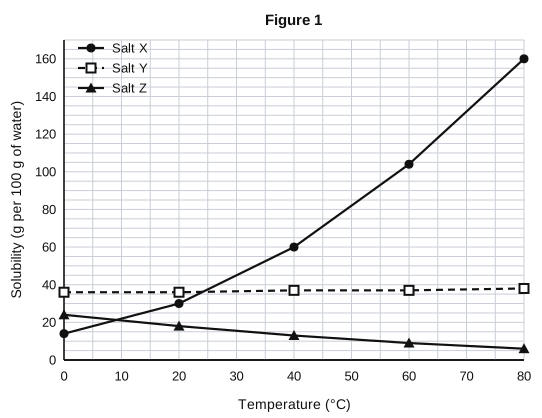
Students measured the solubility of 3 salts (Salts X, Y, and Z) in 100 g of water at 5 temperatures. At each temperature, they added a salt to the water in small portions, stirring for 5 minutes after each addition, until some of the salt remained undissolved. They then filtered the mixture, dried and weighed the undissolved salt, and subtracted that mass from the total mass of salt added. The results are shown in Figure 1.
In this study, the dependent variable was the:
AA. mass of salt that dissolved in 100 g of water.
BB. temperature of the water.
CC. mass of water used.
DD. time spent stirring after each addition.
Antwort und Erklärung anzeigen
Richtige Antwort: A. mass of salt that dissolved in 100 g of water.
Erklärung
The students measured how much salt dissolved (total added minus undissolved): that is the result that depends on the conditions.
Temperature was the variable they chose (independent). The mass of water (100 g) and the stirring time (5 minutes) were kept the same.
Frage 3
Schwierigkeit: schwer≈ 1 min
Passage — Light and algae growth (research summary)
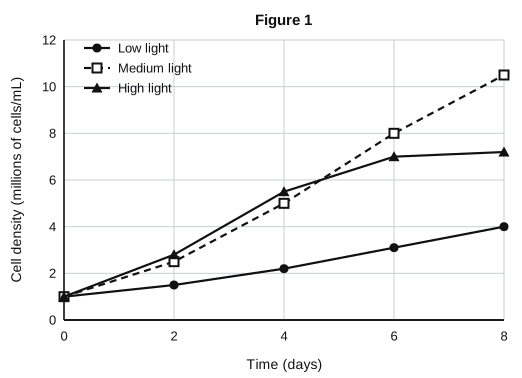
Algae are tiny organisms that grow in water and use light to make food. A student grew cultures of one algae species in flasks of nutrient solution kept at 22°C. Each flask started with 1 million cells per mL, and the density of cells was measured every 2 days for 8 days.
Experiment 1: Flasks were kept under low, medium, or high light. Each flask received 1.0 mg/L of nitrate (see Figure 1).
Experiment 2: Flasks were kept under medium light and given different amounts of nitrate. The cell density on day 8 is shown in Table 1.
Table 1
Nitrate (mg/L)
Cell density on day 8 (millions of cells/mL)
0.1
3.0
0.5
7.2
1.0
10.5
2.0
10.6
A student thinks that the high-light culture stopped growing because it ran out of nitrate. Which of the following would best test this idea?
AA. Repeat Experiment 1 at a higher temperature.
BB. Add nitrate to a high-light flask on day 6 and keep measuring its density.
CC. Remove the high-light flask from the light on day 6.
DD. Count the cells in the medium-light flask on day 10.
Antwort und Erklärung anzeigen
Richtige Antwort: B. Add nitrate to a high-light flask on day 6 and keep measuring its density.
Erklärung
If nitrate was limiting, adding more nitrate on day 6 should restart the growth of the high-light culture, which tests the idea directly. The other options change temperature or light, or look at a different flask, so they do not test a nitrate limit.