Read the title, columns and UNITS before searching.
Step-by-step strategy
Go straight to the table: you don't need the whole text first.
Common traps
Looking at the wrong row or experiment.
Worked example
Greatest O₂ in Experiment 1? Find the largest value in that part of the table.
Sample questions
Try to answer before opening the solution.
Question 1
Difficulty: easy≈ 1 min
Passage VI — Wrapping and cooling (data representation)
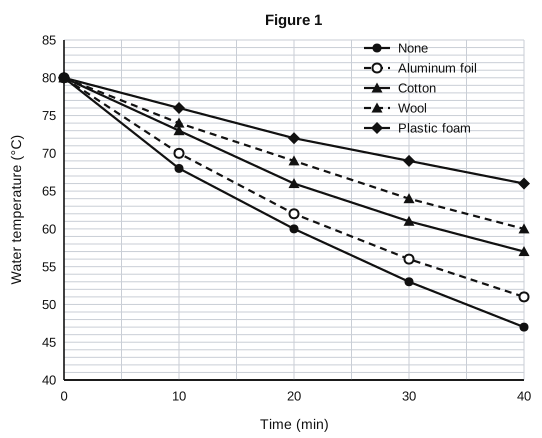
Students tested how well different materials slow the cooling of hot water. They filled 5 identical metal cans with 400 mL of water at 80°C. One can was left unwrapped. Each of the other cans was wrapped in a different material: aluminum foil (a single layer), or a 1.0 cm thick layer of cotton, wool, or plastic foam. The cans were placed on a wooden table in a room kept at 21°C, and the water temperature in each can was recorded every 10 minutes for 40 minutes. The results are shown in Figure 1.
According to Figure 1, what was the water temperature in the can wrapped in wool after 20 minutes?
AA. 66°C
BB. 69°C
CC. 72°C
DD. 74°C
Show answer and explanation
Correct answer: B. 69°C
Explanation
Follow the dashed line with triangles (Wool) to 20 min: it is at about 69°C.
66°C is the cotton can at 20 min, 72°C is the plastic foam can at 20 min, and 74°C is the wool can at 10 min.
Question 2
Difficulty: medium≈ 1 min
Passage V — City noise and bird song (data representation)
Male songbirds sing to defend their territories and to attract mates. Traffic noise is mostly low-pitched, so it easily masks (drowns out) the low-pitched parts of a song.
Researchers studied a songbird species that lives in forests, suburbs, and city centers. For each of 12 males, they measured the background noise level in the male’s territory, in decibels (dB), and the lowest frequency in the male’s song, in kilohertz (kHz). A higher frequency is a higher pitch. Figure 1 shows the results, with a line of best fit. Figure 2 shows the average background noise in each of the 3 habitats at dawn and at noon.
According to Figure 1, how many of the 12 males had a lowest song frequency of 3.3 kHz or higher?
AA. 4
BB. 5
CC. 6
DD. 8
Show answer and explanation
Correct answer: A. 4
Explanation
Points at or above the 3.3 kHz gridline: 3.3 kHz (62 dB), 3.4 kHz (65 dB), 3.3 kHz (67 dB), and 3.5 kHz (70 dB), which is 4 males.
5 adds the 3.2 kHz male (57 dB), which is below 3.3 kHz. 6 counts every male above 3.0 kHz, and 8 counts every male at 3.0 kHz or higher.
Question 3
Difficulty: hard≈ 1 min
Passage IV — Why the balloon shrank (conflicting viewpoints)
A teacher inflated a rubber balloon with air at room temperature (22°C) until its circumference was 60 cm, tied it shut, and placed it in a freezer at −18°C. After 1 hour, the balloon’s circumference was 52 cm. Three students offered explanations.
Student 1: Air slowly escapes through tiny pores in rubber. In the freezer, the balloon lost some of its air through the rubber, so it shrank. If the balloon is returned to room temperature, it will stay at about 52 cm, because the lost air cannot come back in.
Student 2: No air escaped. Gas contracts when it is cooled, because its molecules move more slowly and push less on the inside of the balloon. When the balloon warms back up to 22°C, its circumference will return to about 60 cm.
Student 3: The air inside did not change. Instead, rubber shrinks when it gets cold, squeezing the air into a smaller space. When the balloon warms up, the rubber will relax and the balloon will return to about 60 cm. A balloon filled with water instead of air would shrink by the same amount in the freezer.
The balloon’s circumference decreased from 60 cm to 52 cm. By approximately what percent did the circumference decrease?
AA. 8%
BB. 13%
CC. 15%
DD. 52%
Show answer and explanation
Correct answer: B. 13%
Explanation
The decrease was 60 − 52 = 8 cm. As a percent of the original 60 cm, that is 8 ÷ 60 ≈ 0.133, or about 13%.
8% treats the 8 cm decrease as a percent. 15% divides 8 by 52 instead of by 60.