ACT (enhanced, 2025–): format, scoring and free practice
US college admission test. Since 2025 it is shorter: English, Math and Reading (131 questions, 2 h 5 min) plus optional Science (+40 min). Composite score 1–36.
2 h 5 min4 sections171 questionsScore 1–36
Practise for freeFree. You can start without an account. Original questions with explanations.
Official format
Official format: ACT (enhanced, 2025–)
Section
Time
Questions
Score
Format
English
35 min
50
1–36
Several passages (usually 5–7) with numbered underlined portions; each passage has 5 or 10 questions. 4 choices; A is usually NO CHANGE (keep the original). Other questions ask about the passage as a whole (adding or deleting a sentence, order, purpose). 40 items are scored and 10 are field-test items.
Math
50 min
45
1–36
45 stand-alone multiple-choice questions with 4 choices (formerly 5). Numeric choices are usually in order. 41 items are scored and 4 are field-test items.
Reading
40 min
36
1–36
4 passages (literary narrative, social science, humanities and natural science) of about 650–850 words with 9 questions each; one is a pair of shorter texts. 4 choices. 27 items are scored and 9 are field-test items.
Science (optional)
40 min
40
1–36
About 6–7 passages with tables, graphs or descriptions of experiments; one usually presents conflicting viewpoints. 4 choices. 34 items are scored and 6 are field-test items.
Scoring
Each section is scored 1–36. The Composite is the average of English, Math and Reading, rounded to a whole number; Science is optional, reported separately and combined with Math into the STEM score. Only some items in each section count (English 40 of 50, Math 41 of 45, Reading 27 of 36, Science 34 of 40); the rest are unscored field-test items that look identical. This platform shows only a linear ESTIMATE based on percent correct, not the official conversion, which changes from form to form.
Sections and skills
Each skill has a guide with short theory and worked sample questions.
English
Revising and editing: grammar and punctuation, style and precision, and the organization and development of ideas.
Scientific reasoning with data, experiments and competing theories. It does not test memorized facts. It is optional and does not count toward the Composite.
Topic Development: Sum up the paragraph in 3 words before reading the choices.
Number and Quantity: Multiply complex numbers like binomials and replace i2 at the end.
Central Ideas and Summaries: After each paragraph, note its point in 3–4 words.
Reading Tables and Graphs: Go straight to the table: you don't need the whole text first.
Organization, Unity, and Cohesion: Read the sentences before and after and name the relationship before looking at the choices.
Sample questions
Try to answer before opening the solution.
Question 1
Difficulty: easy≈ 1 min
Passage III — The Lead That Isn’t
[1] Despite its name, a pencil’s “lead” contains no lead at all. Its gray core is a blend of clay and graphite, a soft form of carbon. Manufacturers control it’s (21) hardness by adjusting the recipe: more clay produces a harder core that leaves a lighter line, while more graphite produces a softer core and a darker line. Many artists therefore keep several grades on hand. A hard (22) pencil for faint sketch lines and a soft one for deep shadows.
[2] The eraser at the other end—usually made of synthetic rubber, is (23) held in place by a thin metal band called a ferrule. Because graphite marks rest on the surface of the paper instead of soaking into its fibers, they can be removed and taken off (24) with a few strokes of that eraser. Pencils are sold in many stores. (25)
[3] At the factory, powdered graphite and clay are blended with water and pressed into thin rods. The rods are then baked in a kiln at a high temperature that is very hot (26) until they harden. Next, workers lay the rods in parallel grooves cut into a thin slab of cedar and glue a matching grooved slab on top. This wooden sandwich is sliced into individual pencils, each one is (27) shaped, sanded, and painted. (28)
[4] Two centuries later, the basic design has barely changed, and its appeal is easy to understand: a pencil (29) needs no ink, never leaks, and can be sharpened again and again. Pencils remain popular with students and artists alike. (30)
Underlined portion (21): choose the best alternative. If the original version is best, choose NO CHANGE.
AA. NO CHANGE
BB. its
CC. its’
DD. it is
Show answer and explanation
Correct answer: B. its
Explanation
The possessive pronoun “its” is needed: the sentence is about the core’s hardness (the hardness that belongs to it).
NO CHANGE (“it’s”) and “it is” both mean “it is,” which makes no sense here (“control it is hardness”). “Its’” is not a word in standard English.
Question 2
Difficulty: easy≈ 1 min
What is the value of ∣5−12∣−∣−4∣ ?
AA. 3
BB. 7
CC. 11
DD. 21
Show answer and explanation
Correct answer: A. 3
Explanation
∣5−12∣=∣−7∣=7 and ∣−4∣=4, so 7−4=3.
7 ignores the second term, 11 adds 4 instead of subtracting it, and 21 adds all the numbers.
Question 3
Difficulty: easy≈ 1 min
Passage II — Social Science: two passages about free public transit (original texts)
Passage A
When a city removes fares from its buses, ridership almost always rises, sometimes sharply. In the first year after one midsize European city made its buses free, the number of trips grew by more than a third. Supporters see this as proof that fares keep people off public transit and that removing them can ease traffic and cut pollution.
The argument has a simple appeal. A fare is a small but constant reminder that every trip costs money, and for households with little income, that reminder can decide whether a parent takes a job across town or a teenager goes to an after-school program. Free transit, in this view, is less a transportation policy than a way of widening the range of places people can afford to reach.
There are practical benefits as well. Collecting fares is expensive: machines must be bought and repaired, cash must be counted and guarded, and drivers lose time at every stop as passengers search for change. In some small systems, fares bring in barely more money than it costs to collect them. Removing fares also lets passengers board through every door, which shortens stops and makes buses faster for everyone.
Critics sometimes object that free buses will be crowded with people who would otherwise have walked. But a trip that replaces a walk still carries a person somewhere they wanted to go. Measured by how many people can reach work, school, and medical care, free transit succeeds.
Passage B
The rise in ridership after fares are removed is real, but it is worth asking where the new riders come from. Studies of several fare-free programs have found that many of the added trips were made by people who previously walked or rode bicycles, not by people who previously drove. Traffic and pollution, the problems free transit is often promised to solve, barely changed.
This matters because fares, though unpopular, pay for a share of the service. In many large systems they cover a quarter or more of operating costs. When that money disappears, it must be replaced by taxes, or else the system must cut service. And service, more than price, is what most riders say they care about. A bus that is free but comes every forty minutes is less useful to a worker than one that costs a little and comes every ten.
None of this means that fares should be high or that low-income riders should be left to struggle. Many cities offer reduced fares to students, older adults, and people with low incomes, which helps those who most need it without giving up revenue from those who can pay. The money that a city would spend replacing all fare revenue could instead pay for more frequent buses, new routes, and better shelters.
Free transit is a generous idea. But generosity in transportation is measured less by what a ride costs than by whether the bus shows up.
According to Passage A, one practical benefit of removing fares is that:
AA. drivers can be paid more.
BB. buses can be replaced by trains.
CC. passengers can board through every door, which shortens stops.
DD. cities no longer need to repair their buses.
Show answer and explanation
Correct answer: C. passengers can board through every door, which shortens stops.
Explanation
Passage A states that removing fares “lets passengers board through every door, which shortens stops and makes buses faster for everyone.”
The passage says nothing about pay, trains, or ending bus repairs (it mentions repairing fare machines).
Question 4
Difficulty: easy≈ 1 min
Passage VI — Wrapping and cooling (data representation)
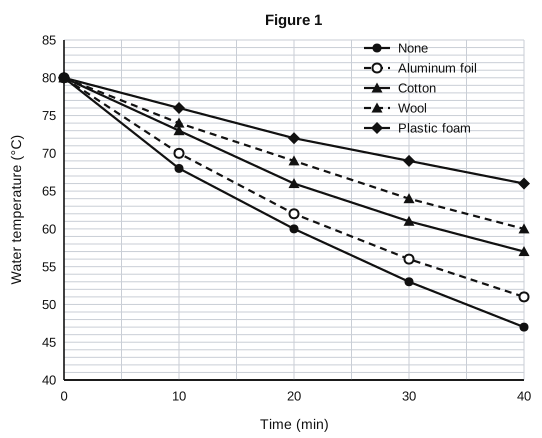
Students tested how well different materials slow the cooling of hot water. They filled 5 identical metal cans with 400 mL of water at 80°C. One can was left unwrapped. Each of the other cans was wrapped in a different material: aluminum foil (a single layer), or a 1.0 cm thick layer of cotton, wool, or plastic foam. The cans were placed on a wooden table in a room kept at 21°C, and the water temperature in each can was recorded every 10 minutes for 40 minutes. The results are shown in Figure 1.
According to Figure 1, what was the water temperature in the can wrapped in wool after 20 minutes?
AA. 66°C
BB. 69°C
CC. 72°C
DD. 74°C
Show answer and explanation
Correct answer: B. 69°C
Explanation
Follow the dashed line with triangles (Wool) to 20 min: it is at about 69°C.
66°C is the cotton can at 20 min, 72°C is the plastic foam can at 20 min, and 74°C is the wool can at 10 min.
Frequently asked questions
How long is the ACT exam?
2 h 5 min in total, plus a 10 min break. Sections: English (35 min), Math (50 min), Reading (40 min), Science (optional) (40 min).
How is the ACT scored?
Overall scale 1–36. Each section is scored 1–36. The Composite is the average of English, Math and Reading, rounded to a whole number; Science is optional, reported separately and combined with Math into the STEM score. Only some items in each section count (English 40 of 50, Math 41 of 45, Reading 27 of 36, Science 34 of 40); the rest are unscored field-test items that look identical. This platform shows only a linear ESTIMATE based on percent correct, not the official conversion, which changes from form to form.
Are the examARnow questions official?
No. They are original questions that follow the format published by ACT, Inc., each one reviewed. examARnow is not affiliated with ACT, Inc..
Is ACT practice on examARnow free?
Yes. You can start without an account; after a few exercises it suggests creating a free account to save your progress.
How many ACT practice questions are there?
2589 reviewed original questions across 26 skills.
What we checked: Verified (several sources agree, including ACT's own counselor blog as quoted by search): since April 2025 (online) and September 2025 (all versions) the ACT has English 50 items/35 min, Math 45 items/50 min, Reading 36 items/40 min and optional Science 40 items/40 min; 131 items and 2 h 5 min without the optional parts; Math has 4 answer choices (formerly 5); Composite = average of English, Math and Reading; unscored field-test items embedded in every section (10/4/9/6); Reading has 4 passages of 9 questions, one of them a paired passage; reporting categories for English, Reading and Science. NOT verified or sources disagree: (1) the break after Math: some sources say 10 min, others 15; (2) the exact weight of Preparing for Higher Math (secondary sources say ≈80%, versus 57–60% on the legacy test) and the split among its 5 subcategories; (3) the share of Integration of Knowledge and Ideas in Reading; (4) the exact number of English passages (5–7, with 5 or 10 questions) and Science passages (≈6–7) varies by form; (5) optional Writing lasts 40 min, but its current format was not reviewed and it is not included. act.org could not be opened directly (network blocked); everything was cross-checked through web search.
Practise for freeFree. You can start without an account. Original questions with explanations.