Posición, velocidad y aceleración son derivadas sucesivas.
Estrategia paso a paso
En tasas relacionadas, dibuja y deriva respecto al tiempo.
Trampas habituales
Sustituir los números antes de derivar.
Preguntas de ejemplo
Intenta responder antes de abrir la solución. Las preguntas están en el idioma del examen.
Pregunta 1
Dificultad: media≈ 2 min
A particle moves along a line with position s(t)=2t3−12t2+18t for t≥0. At what time t>1 is the particle at rest?
AA. 4
BB. 1
CC. 3
DD. 2
Ver respuesta y explicación
Respuesta correcta: C. 3
Explicación
Velocity: v(t)=6t2−24t+18=6(t−1)(t−3). It is zero at t = 1 and t = 3; the only one with t > 1 is 3.
Pregunta 2
Dificultad: media≈ 2 min
A particle moves along a line with position s(t)=2t3−21t2+60t for t≥0. At what time t>2 is the particle at rest?
AA. 7
BB. 10
CC. 2
DD. 5
Ver respuesta y explicación
Respuesta correcta: D. 5
Explicación
Velocity: v(t)=6t2−42t+60=6(t−2)(t−5). It is zero at t = 2 and t = 5; the only one with t > 2 is 5.
Pregunta 3
Dificultad: difícil≈ 3 min
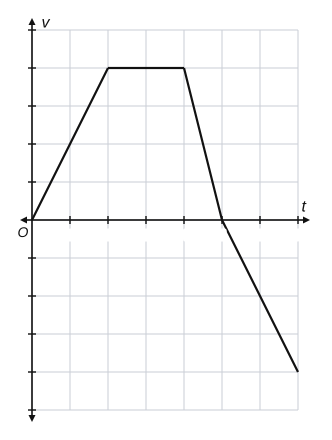
A particle moves along a line with velocity v(t) shown. At t=6, which statement is true?
AA. The particle is moving right and speeding up.
BB. The particle is moving right and slowing down.
CC. The particle is moving left and speeding up.
DD. The particle is moving left and slowing down.
Ver respuesta y explicación
Respuesta correcta: C. The particle is moving left and speeding up.
Explicación
At t = 6 the velocity is −2 (negative), so the particle moves left. On 5 < t < 7 the graph has slope −2, so the acceleration is negative. Velocity and acceleration have the same sign, so the speed is increasing: moving left and speeding up.