Position, velocity and acceleration are successive derivatives.
Step-by-step strategy
In related rates, sketch and differentiate with respect to time.
Common traps
Plugging numbers in before differentiating.
Sample questions
Try to answer before opening the solution.
Question 1
Difficulty: medium≈ 2 min
A particle moves along a line with position s(t)=2t3−12t2+18t for t≥0. At what time t>1 is the particle at rest?
AA. 4
BB. 1
CC. 3
DD. 2
Show answer and explanation
Correct answer: C. 3
Explanation
Velocity: v(t)=6t2−24t+18=6(t−1)(t−3). It is zero at t = 1 and t = 3; the only one with t > 1 is 3.
Question 2
Difficulty: medium≈ 2 min
A particle moves along a line with position s(t)=2t3−21t2+60t for t≥0. At what time t>2 is the particle at rest?
AA. 7
BB. 10
CC. 2
DD. 5
Show answer and explanation
Correct answer: D. 5
Explanation
Velocity: v(t)=6t2−42t+60=6(t−2)(t−5). It is zero at t = 2 and t = 5; the only one with t > 2 is 5.
Question 3
Difficulty: hard≈ 3 min
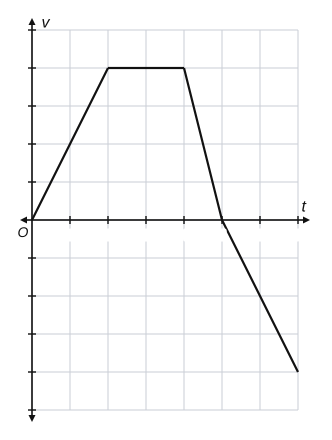
A particle moves along a line with velocity v(t) shown. At t=6, which statement is true?
AA. The particle is moving right and speeding up.
BB. The particle is moving right and slowing down.
CC. The particle is moving left and speeding up.
DD. The particle is moving left and slowing down.
Show answer and explanation
Correct answer: C. The particle is moving left and speeding up.
Explanation
At t = 6 the velocity is −2 (negative), so the particle moves left. On 5 < t < 7 the graph has slope −2, so the acceleration is negative. Velocity and acceleration have the same sign, so the speed is increasing: moving left and speeding up.