Comprendre, comparer et appliquer des explications scientifiques concurrentes.
L'essentiel
Peu importe qui a raison dans la réalité : réponds à partir de chaque texte.
Méthode pas à pas
Résume chaque point de vue en une ligne et marque où ils diffèrent.
Pièges fréquents
Attribuer l'idée d'un élève à l'autre.
Exemple corrigé
Student 1: O₂ is used up. Student 2: the gas cools. Both: the pressure inside drops.
Exemples de questions
Essayez de répondre avant d'ouvrir le corrigé. Les questions sont dans la langue de l'examen.
Question 1
Difficulté: facile≈ 1 min
Passage IV — Why the balloon shrank (conflicting viewpoints)
A teacher inflated a rubber balloon with air at room temperature (22°C) until its circumference was 60 cm, tied it shut, and placed it in a freezer at −18°C. After 1 hour, the balloon’s circumference was 52 cm. Three students offered explanations.
Student 1: Air slowly escapes through tiny pores in rubber. In the freezer, the balloon lost some of its air through the rubber, so it shrank. If the balloon is returned to room temperature, it will stay at about 52 cm, because the lost air cannot come back in.
Student 2: No air escaped. Gas contracts when it is cooled, because its molecules move more slowly and push less on the inside of the balloon. When the balloon warms back up to 22°C, its circumference will return to about 60 cm.
Student 3: The air inside did not change. Instead, rubber shrinks when it gets cold, squeezing the air into a smaller space. When the balloon warms up, the rubber will relax and the balloon will return to about 60 cm. A balloon filled with water instead of air would shrink by the same amount in the freezer.
Which student claimed that some of the air left the balloon?
AA. Student 1 only
BB. Student 2 only
CC. Student 3 only
DD. Students 2 and 3 only
Voir la réponse et l'explication
Bonne réponse: A. Student 1 only
Explication
Student 1 says the balloon “lost some of its air through the rubber.” Student 2 says “No air escaped,” and Student 3 says “The air inside did not change.”
Question 2
Difficulté: moyenne≈ 1 min
Passage III — Earthquake waves at 6 stations (data representation)
An earthquake releases 2 main types of waves that travel through Earth’s interior: P waves, which travel faster, and S waves, which travel more slowly. Both types leave the earthquake’s epicenter at the same moment, so the farther a seismic station is from the epicenter, the greater the time difference between the arrival of the P waves and the arrival of the S waves (the S–P interval).
The S–P interval at a single station tells how far the epicenter is from that station, but not in which direction. Seismologists therefore draw a circle around each station with a radius equal to that station’s distance from the epicenter. The epicenter is located where the circles from 3 or more stations intersect.
Table 1 shows the arrival times of P waves and S waves, measured in seconds (s) after the earthquake occurred, at 6 stations at known distances from the epicenter of one earthquake.
Table 1
Station
Distance from epicenter (km)
P-wave arrival (s)
S-wave arrival (s)
A
100
17
29
B
200
33
57
C
300
50
86
D
400
67
114
E
500
83
143
F
600
100
171
Suppose only 2 stations had recorded a different earthquake. According to the method described in the passage, the seismologists could conclude that the epicenter was located at:
AA. the station that recorded the shorter S–P interval.
BB. a point exactly halfway between the 2 stations.
CC. any point inside the larger of the 2 circles.
DD. one of the 2 points where the 2 circles intersect, but not which one.
Voir la réponse et l'explication
Bonne réponse: D. one of the 2 points where the 2 circles intersect, but not which one.
Explication
Each station gives only a distance, drawn as a circle. Two circles generally cross at 2 points, so the epicenter must be at one of them; a third station is needed to decide which. That is why the passage says 3 or more stations are used.
The epicenter is not at a station or necessarily halfway between them, and it must lie on both circles, not anywhere inside one.
Question 3
Difficulté: difficile≈ 1 min
Passage — Salt and seed germination (research summary)
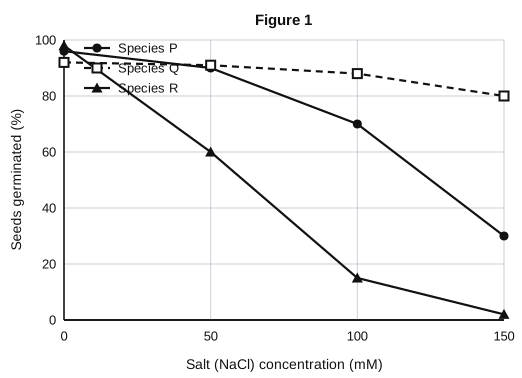
Salty soil can keep seeds from germinating. Researchers tested seeds of three plant species, P, Q and R. In each trial, 100 seeds were placed on moist paper that was soaked with a salt (NaCl) solution, and the percent of seeds that germinated after 7 days was recorded. The concentration of salt is given in millimolar (mM).
Experiment 1: Seeds of each species were tested at 4 salt concentrations at 25°C (see Figure 1).
Experiment 2: Seeds of species R were tested at a salt concentration of 50 mM at 4 temperatures (see Table 1).
Table 1
Temperature (°C)
Seeds germinated (%)
10
41
20
58
30
63
40
22
A farmer has soil that is expected to have a salt concentration of about 120 mM and will plant at 25°C. Based on Figure 1, which species is the best choice to get the highest germination?
AA. Species P
BB. Species Q
CC. Species R
DD. Any of the three; the species do not differ at 120 mM
Voir la réponse et l'explication
Bonne réponse: B. Species Q
Explication
At 100 mM species Q was at 88% and at 150 mM at 80%, so at 120 mM it stays above 80%. Species P is between 70% and 30% and species R is below 15%. Q is the best choice.