ACT (enhanced, 2025–) : format, score et entraînement gratuit
Test d'admission aux universités américaines. Depuis 2025, il est plus court : English, Math et Reading (131 questions, 2 h 5 min) plus Science facultatif (+40 min). Score composite de 1–36.
2 h 5 min4 épreuves171 questionsNote 1–36
S'entraîner gratuitementGratuit. Vous pouvez commencer sans compte. Questions originales avec explications.
Format officiel
Format officiel: ACT (enhanced, 2025–)
Épreuve
Durée
Questions
Note
Format
English
35 min
50
1–36
Plusieurs textes (généralement 5–7) avec des passages soulignés numérotés ; chaque texte comporte 5 ou 10 questions. 4 choix ; A est généralement NO CHANGE (conserver l'original). D'autres questions portent sur le texte dans son ensemble (ajout ou suppression d'une phrase, ordre, objectif). 40 items sont notés et 10 sont des items d'essai.
Math
50 min
45
1–36
45 questions à choix multiple indépendantes, à 4 choix (auparavant 5). Les choix numériques sont généralement classés dans l'ordre. 41 items sont notés et 4 sont des items d'essai.
Reading
40 min
36
1–36
4 textes (récit littéraire, sciences sociales, sciences humaines et sciences naturelles) d'environ 650–850 mots, avec 9 questions chacun ; l'un d'eux est une paire de textes plus courts. 4 choix. 27 items sont notés et 9 sont des items d'essai.
Science (optional)
40 min
40
1–36
Environ 6–7 textes avec des tableaux, des graphiques ou des descriptions d'expériences ; l'un présente généralement des points de vue divergents. 4 choix. 34 items sont notés et 6 sont des items d'essai.
Notation
Chaque section est notée de 1–36. Le Composite est la moyenne d'English, Math et Reading, arrondie à l'entier ; Science est facultatif, rapporté séparément et combiné à Math pour obtenir le score STEM. Seule une partie des items de chaque section compte (English 40 sur 50, Math 41 sur 45, Reading 27 sur 36, Science 34 sur 40) ; les autres sont des items d'essai non notés qui semblent identiques. Cette plateforme n'affiche qu'une ESTIMATION linéaire fondée sur le pourcentage de réponses correctes, et non la conversion officielle, qui change d'une forme à l'autre.
Épreuves et compétences
Chaque compétence a un guide avec un cours bref et des questions corrigées.
English
Révision et correction : grammaire et ponctuation, style et précision, ainsi qu'organisation et développement des idées.
Mathématiques jusqu'aux premières années du lycée : nombres, algèbre, fonctions, géométrie, statistiques et problèmes appliqués. Calculatrice autorisée.
Preparing for Higher Math · ≈80 % (fuentes secundarias)
Raisonnement scientifique à partir de données, d'expériences et de théories concurrentes. Il ne teste pas des connaissances mémorisées. Il est facultatif et ne compte pas dans le Composite.
Topic Development: Résume le paragraphe en 3 mots avant de lire les choix.
Number and Quantity: Multiplie les nombres complexes comme des binômes et remplace i2 à la fin.
Central Ideas and Summaries: Après chaque paragraphe, note son idée en 3 à 4 mots.
Reading Tables and Graphs: Va directement au tableau : inutile de lire tout le texte d'abord.
Organization, Unity, and Cohesion: Lis les phrases d'avant et d'après et nomme la relation avant de regarder les choix.
Exemples de questions
Essayez de répondre avant d'ouvrir le corrigé. Les questions sont dans la langue de l'examen.
Question 1
Difficulté: facile≈ 1 min
Passage III — The Lead That Isn’t
[1] Despite its name, a pencil’s “lead” contains no lead at all. Its gray core is a blend of clay and graphite, a soft form of carbon. Manufacturers control it’s (21) hardness by adjusting the recipe: more clay produces a harder core that leaves a lighter line, while more graphite produces a softer core and a darker line. Many artists therefore keep several grades on hand. A hard (22) pencil for faint sketch lines and a soft one for deep shadows.
[2] The eraser at the other end—usually made of synthetic rubber, is (23) held in place by a thin metal band called a ferrule. Because graphite marks rest on the surface of the paper instead of soaking into its fibers, they can be removed and taken off (24) with a few strokes of that eraser. Pencils are sold in many stores. (25)
[3] At the factory, powdered graphite and clay are blended with water and pressed into thin rods. The rods are then baked in a kiln at a high temperature that is very hot (26) until they harden. Next, workers lay the rods in parallel grooves cut into a thin slab of cedar and glue a matching grooved slab on top. This wooden sandwich is sliced into individual pencils, each one is (27) shaped, sanded, and painted. (28)
[4] Two centuries later, the basic design has barely changed, and its appeal is easy to understand: a pencil (29) needs no ink, never leaks, and can be sharpened again and again. Pencils remain popular with students and artists alike. (30)
Underlined portion (21): choose the best alternative. If the original version is best, choose NO CHANGE.
AA. NO CHANGE
BB. its
CC. its’
DD. it is
Voir la réponse et l'explication
Bonne réponse: B. its
Explication
The possessive pronoun “its” is needed: the sentence is about the core’s hardness (the hardness that belongs to it).
NO CHANGE (“it’s”) and “it is” both mean “it is,” which makes no sense here (“control it is hardness”). “Its’” is not a word in standard English.
Question 2
Difficulté: facile≈ 1 min
What is the value of ∣5−12∣−∣−4∣ ?
AA. 3
BB. 7
CC. 11
DD. 21
Voir la réponse et l'explication
Bonne réponse: A. 3
Explication
∣5−12∣=∣−7∣=7 and ∣−4∣=4, so 7−4=3.
7 ignores the second term, 11 adds 4 instead of subtracting it, and 21 adds all the numbers.
Question 3
Difficulté: facile≈ 1 min
Passage II — Social Science: two passages about free public transit (original texts)
Passage A
When a city removes fares from its buses, ridership almost always rises, sometimes sharply. In the first year after one midsize European city made its buses free, the number of trips grew by more than a third. Supporters see this as proof that fares keep people off public transit and that removing them can ease traffic and cut pollution.
The argument has a simple appeal. A fare is a small but constant reminder that every trip costs money, and for households with little income, that reminder can decide whether a parent takes a job across town or a teenager goes to an after-school program. Free transit, in this view, is less a transportation policy than a way of widening the range of places people can afford to reach.
There are practical benefits as well. Collecting fares is expensive: machines must be bought and repaired, cash must be counted and guarded, and drivers lose time at every stop as passengers search for change. In some small systems, fares bring in barely more money than it costs to collect them. Removing fares also lets passengers board through every door, which shortens stops and makes buses faster for everyone.
Critics sometimes object that free buses will be crowded with people who would otherwise have walked. But a trip that replaces a walk still carries a person somewhere they wanted to go. Measured by how many people can reach work, school, and medical care, free transit succeeds.
Passage B
The rise in ridership after fares are removed is real, but it is worth asking where the new riders come from. Studies of several fare-free programs have found that many of the added trips were made by people who previously walked or rode bicycles, not by people who previously drove. Traffic and pollution, the problems free transit is often promised to solve, barely changed.
This matters because fares, though unpopular, pay for a share of the service. In many large systems they cover a quarter or more of operating costs. When that money disappears, it must be replaced by taxes, or else the system must cut service. And service, more than price, is what most riders say they care about. A bus that is free but comes every forty minutes is less useful to a worker than one that costs a little and comes every ten.
None of this means that fares should be high or that low-income riders should be left to struggle. Many cities offer reduced fares to students, older adults, and people with low incomes, which helps those who most need it without giving up revenue from those who can pay. The money that a city would spend replacing all fare revenue could instead pay for more frequent buses, new routes, and better shelters.
Free transit is a generous idea. But generosity in transportation is measured less by what a ride costs than by whether the bus shows up.
According to Passage A, one practical benefit of removing fares is that:
AA. drivers can be paid more.
BB. buses can be replaced by trains.
CC. passengers can board through every door, which shortens stops.
DD. cities no longer need to repair their buses.
Voir la réponse et l'explication
Bonne réponse: C. passengers can board through every door, which shortens stops.
Explication
Passage A states that removing fares “lets passengers board through every door, which shortens stops and makes buses faster for everyone.”
The passage says nothing about pay, trains, or ending bus repairs (it mentions repairing fare machines).
Question 4
Difficulté: facile≈ 1 min
Passage VI — Wrapping and cooling (data representation)
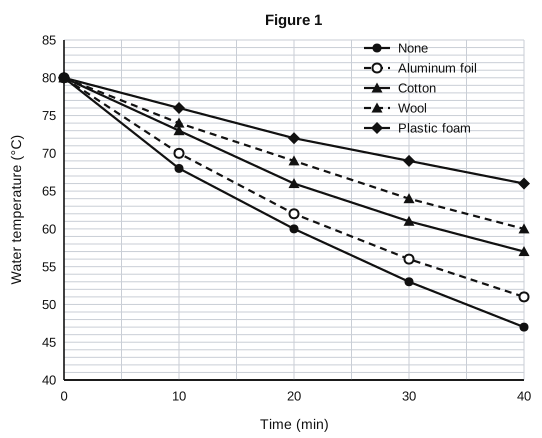
Students tested how well different materials slow the cooling of hot water. They filled 5 identical metal cans with 400 mL of water at 80°C. One can was left unwrapped. Each of the other cans was wrapped in a different material: aluminum foil (a single layer), or a 1.0 cm thick layer of cotton, wool, or plastic foam. The cans were placed on a wooden table in a room kept at 21°C, and the water temperature in each can was recorded every 10 minutes for 40 minutes. The results are shown in Figure 1.
According to Figure 1, what was the water temperature in the can wrapped in wool after 20 minutes?
AA. 66°C
BB. 69°C
CC. 72°C
DD. 74°C
Voir la réponse et l'explication
Bonne réponse: B. 69°C
Explication
Follow the dashed line with triangles (Wool) to 20 min: it is at about 69°C.
66°C is the cotton can at 20 min, 72°C is the plastic foam can at 20 min, and 74°C is the wool can at 10 min.
Questions fréquentes
Combien de temps dure l'examen ACT ?
2 h 5 min au total, plus 10 min de pause. Épreuves : English (35 min), Math (50 min), Reading (40 min), Science (optional) (40 min).
Comment l'examen ACT est-il noté ?
Échelle globale 1–36. Chaque section est notée de 1–36. Le Composite est la moyenne d'English, Math et Reading, arrondie à l'entier ; Science est facultatif, rapporté séparément et combiné à Math pour obtenir le score STEM. Seule une partie des items de chaque section compte (English 40 sur 50, Math 41 sur 45, Reading 27 sur 36, Science 34 sur 40) ; les autres sont des items d'essai non notés qui semblent identiques. Cette plateforme n'affiche qu'une ESTIMATION linéaire fondée sur le pourcentage de réponses correctes, et non la conversion officielle, qui change d'une forme à l'autre.
Les questions de examARnow sont-elles officielles ?
Non. Ce sont des questions originales qui suivent le format publié par ACT, Inc., relues une à une. examARnow n'est pas affilié à ACT, Inc..
S'entraîner au ACT sur examARnow est-il gratuit ?
Oui. Vous pouvez commencer sans compte ; après quelques exercices, l'appli propose de créer un compte gratuit pour enregistrer votre progression.
Combien de questions d'entraînement ACT y a-t-il ?
2589 questions originales relues, réparties en 26 compétences.
Ce que nous avons vérifié : Vérifié (plusieurs sources concordent, dont le blog officiel d'ACT destiné aux conseillers, tel que cité par le moteur de recherche) : depuis avril 2025 (en ligne) et septembre 2025 (toutes versions), l'ACT comprend English 50 items/35 min, Math 45 items/50 min, Reading 36 items/40 min et Science facultatif 40 items/40 min ; 131 items et 2 h 5 min sans les parties facultatives ; Math propose 4 choix de réponse (auparavant 5) ; Composite = moyenne d'English, Math et Reading ; des items d'essai non notés sont intégrés à chaque section (10/4/9/6) ; Reading comprend 4 textes de 9 questions, dont un texte apparié ; des catégories de résultats existent pour English, Reading et Science. NON vérifié ou sources divergentes : (1) la pause après Math : certaines sources indiquent 10 min, d'autres 15 ; (2) le poids exact de Preparing for Higher Math (des sources secondaires indiquent ≈80 %, contre 57–60 % dans l'ancien test) et la répartition entre ses 5 sous-catégories ; (3) la part d'Integration of Knowledge and Ideas dans Reading ; (4) le nombre exact de textes d'English (5–7, avec 5 ou 10 questions) et de textes de Science (≈6–7) varie selon la forme ; (5) l'épreuve facultative de Writing dure 40 min, mais son format actuel n'a pas été examiné et n'est pas inclus. act.org n'a pas pu être ouvert directement (réseau bloqué) ; tout a été recoupé par recherche web.
S'entraîner gratuitementGratuit. Vous pouvez commencer sans compte. Questions originales avec explications.