Teste chaque modèle avec deux ou trois points du tableau.
Pièges fréquents
Interpréter la pente comme si c'était la valeur initiale.
Exemple corrigé
Droite de régression y=3x+2 : pour x=4, elle prédit 14. Si la valeur réelle est 15, le résidu est 15−14=1.
Exemples de questions
Essayez de répondre avant d'ouvrir le corrigé. Les questions sont dans la langue de l'examen.
Question 1
Difficulté: facile≈ 1 min
A line of best fit for a scatterplot of y versus x has equation y=2.5x+14. What is the predicted value of y when x=8?
Réponse numérique (vous écrivez le nombre).
Voir la réponse et l'explication
Réponse: 34
Explication
Substitute x=8: y=2.5(8)+14=20+14=34.
The line gives a prediction; actual data points may differ.
Question 2
Difficulté: moyenne≈ 1 min
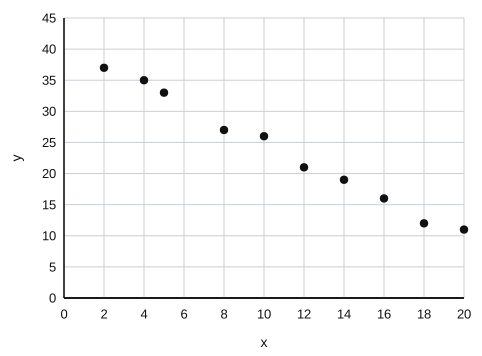
Which of the following equations best models the data in the scatterplot?
AA. y=1.5x+40
BB. y=−0.2x+40
CC. y=−1.5x+10
DD. y=−1.5x+40
Voir la réponse et l'explication
Bonne réponse: D. y=−1.5x+40
Explication
The points fall from left to right, so the slope is negative. Moving from about (2,37) to (20,11), y decreases about 26 while x increases 18, a slope of about −1.4. Extending the trend back to x=0 gives a y-intercept near 40. So y=−1.5x+40 fits best.
y=1.5x+40 rises instead of falling. y=−1.5x+10 has a y-intercept far below the data. y=−0.2x+40 is much too flat: at x=20 it gives 36, not about 11.
Question 3
Difficulté: difficile≈ 2 min
x
y
1
6
3
24
5
96
7
384
The table shows four pairs of values of x and y. Which of the following equations models the relationship between x and y exactly for all four pairs?
AA. y=3(2)x
BB. y=3(4)x
CC. y=6(2)x
DD. y=6(4)x
Voir la réponse et l'explication
Bonne réponse: A. y=3(2)x
Explication
Each time x increases by 2, y is multiplied by 4 (6→24→96→384). So when x increases by 1, y is multiplied by 4=2, and the model has the form y=a(2)x. Using (1,6): 6=a(2)1, so a=3 and y=3(2)x. Check: 3(2)7=3(128)=384.
y=3(4)x and y=6(4)x treat 4 as the growth factor for each increase of 1 in x. y=6(2)x uses the first y-value as if it occurred at x=0.