Prueba cada modelo con dos o tres puntos de la tabla.
Trampas habituales
Interpretar la pendiente como si fuera el valor inicial.
Ejemplo resuelto
Recta de ajuste y=3x+2: para x=4 predice 14. Si el valor real es 15, el residuo es 15−14=1.
Preguntas de ejemplo
Intenta responder antes de abrir la solución. Las preguntas están en el idioma del examen.
Pregunta 1
Dificultad: fácil≈ 1 min
A line of best fit for a scatterplot of y versus x has equation y=2.5x+14. What is the predicted value of y when x=8?
Respuesta numérica (escribes el número).
Ver respuesta y explicación
Respuesta: 34
Explicación
Substitute x=8: y=2.5(8)+14=20+14=34.
The line gives a prediction; actual data points may differ.
Pregunta 2
Dificultad: media≈ 1 min
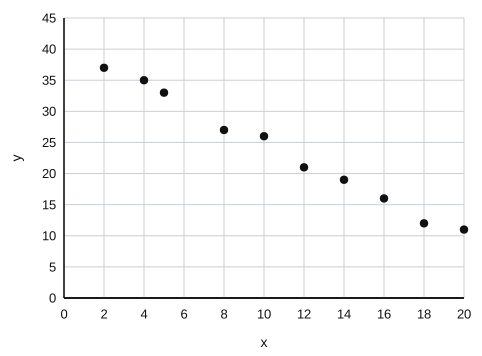
Which of the following equations best models the data in the scatterplot?
AA. y=1.5x+40
BB. y=−0.2x+40
CC. y=−1.5x+10
DD. y=−1.5x+40
Ver respuesta y explicación
Respuesta correcta: D. y=−1.5x+40
Explicación
The points fall from left to right, so the slope is negative. Moving from about (2,37) to (20,11), y decreases about 26 while x increases 18, a slope of about −1.4. Extending the trend back to x=0 gives a y-intercept near 40. So y=−1.5x+40 fits best.
y=1.5x+40 rises instead of falling. y=−1.5x+10 has a y-intercept far below the data. y=−0.2x+40 is much too flat: at x=20 it gives 36, not about 11.
Pregunta 3
Dificultad: difícil≈ 2 min
x
y
1
6
3
24
5
96
7
384
The table shows four pairs of values of x and y. Which of the following equations models the relationship between x and y exactly for all four pairs?
AA. y=3(2)x
BB. y=3(4)x
CC. y=6(2)x
DD. y=6(4)x
Ver respuesta y explicación
Respuesta correcta: A. y=3(2)x
Explicación
Each time x increases by 2, y is multiplied by 4 (6→24→96→384). So when x increases by 1, y is multiplied by 4=2, and the model has the form y=a(2)x. Using (1,6): 6=a(2)1, so a=3 and y=3(2)x. Check: 3(2)7=3(128)=384.
y=3(4)x and y=6(4)x treat 4 as the growth factor for each increase of 1 in x. y=6(2)x uses the first y-value as if it occurred at x=0.