SAT · Math · Geometry and Trigonometry
Right triangles and trigonometry
Teorema de Pitágoras y razones trigonométricas (seno, coseno, tangente) en triángulos rectángulos.
Digital SATMathPeso: ≈15 % · 5–7 preguntas
Claves
- SOH-CAH-TOA: sen = opuesto/hipotenusa, cos = contiguo/hipotenusa, tan = opuesto/contiguo.
- sen(x∘)=cos(90∘−x∘).
Estrategia paso a paso
- Dibuja el triángulo, marca el ángulo y etiqueta opuesto, contiguo e hipotenusa desde ese ángulo.
Trampas habituales
- Tomar los lados desde el otro ángulo agudo.
Ejemplo resuelto
Triángulo 3−4−5, con A opuesto al lado 3: senA=53, cosA=54, tanA=43.
Preguntas de ejemplo
Intenta responder antes de abrir la solución. Las preguntas están en el idioma del examen.
Pregunta 1
Dificultad: fácil≈ 1 min
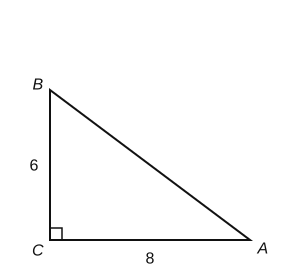
In right triangle ABC shown, what is the length of AB?
- AA. 7
- BB. 10
- CC. 14
- DD. 48
Ver respuesta y explicación
Respuesta correcta: B. 10
Explicación
By the Pythagorean theorem, AB2=62+82=36+64=100, so AB=10.
14 adds the legs. 7 is their average. 48 multiplies them.
Pregunta 2
Dificultad: media≈ 1 min
An angle measures 65π radians. What is its measure in degrees?
- AA. 30
- BB. 75
- CC. 150
- DD. 300
Ver respuesta y explicación
Respuesta correcta: C. 150
Explicación
Multiply by π180∘: 65π⋅π180=5⋅30=150∘.
30 is 6π; 300 is 35π.
Pregunta 3
Dificultad: difícil≈ 1 min
In right triangle PQR, the right angle is at Q. If sinP=23, what is the measure, in degrees, of angle R?
Respuesta numérica (escribes el número).
Ver respuesta y explicación
Respuesta: 30
Explicación
sinP=23 means angle P=60∘. The acute angles are complementary, so angle R=90−60=30∘.
Confusing sin60∘ with sin30∘=21 would give R=60.
Sigue practicando
Otras destrezas de Math
Estructura completa del examen SAT · Todas las guías