SAT · Math · Geometry and Trigonometry
Right triangles and trigonometry
The Pythagorean theorem and trigonometric ratios (sine, cosine, tangent) in right triangles.
Digital SATMathWeight: ≈15% · 5–7 questions
Key points
- SOH-CAH-TOA: sin = opposite/hypotenuse, cos = adjacent/hypotenuse, tan = opposite/adjacent.
- sin(x∘)=cos(90∘−x∘).
Step-by-step strategy
- Draw the triangle, mark the angle, and label opposite, adjacent, and hypotenuse from that angle.
Common traps
- Reading the sides from the other acute angle.
Worked example
3−4−5 triangle, with A opposite the side of length 3: sinA=53, cosA=54, tanA=43.
Sample questions
Try to answer before opening the solution.
Question 1
Difficulty: easy≈ 1 min
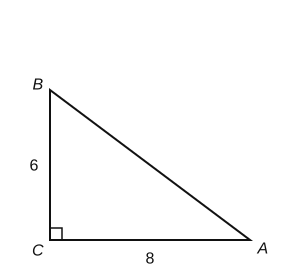
In right triangle ABC shown, what is the length of AB?
- AA. 7
- BB. 10
- CC. 14
- DD. 48
Show answer and explanation
Correct answer: B. 10
Explanation
By the Pythagorean theorem, AB2=62+82=36+64=100, so AB=10.
14 adds the legs. 7 is their average. 48 multiplies them.
Question 2
Difficulty: medium≈ 1 min
An angle measures 65π radians. What is its measure in degrees?
- AA. 30
- BB. 75
- CC. 150
- DD. 300
Show answer and explanation
Correct answer: C. 150
Explanation
Multiply by π180∘: 65π⋅π180=5⋅30=150∘.
30 is 6π; 300 is 35π.
Question 3
Difficulty: hard≈ 1 min
In right triangle PQR, the right angle is at Q. If sinP=23, what is the measure, in degrees, of angle R?
Numeric answer (you type the number).
Show answer and explanation
Answer: 30
Explanation
sinP=23 means angle P=60∘. The acute angles are complementary, so angle R=90−60=30∘.
Confusing sin60∘ with sin30∘=21 would give R=60.
Keep practising
Other Math skills
Full SAT format · All guides