SAT · Math · Advanced Math
Nonlinear functions
Quadratic and exponential functions: evaluate them, find maximums or minimums, shifts, and interpret growth rates.
Digital SATMathWeight: ≈35% · 13–15 questions
Key points
- The vertex of ax2+bx+c is at x=−2ab; in a(x−h)2+k the vertex is (h,k).
- Exponential a⋅bt: b>1 grows by (b−1)⋅100%; b<1 decays by (1−b)⋅100%.
- f(x−3) shifts the graph 3 units to the RIGHT.
Step-by-step strategy
- Rewrite exponents like 2t to see the yearly rate: 1.21t/2=1.1t (a 10% increase per year).
Common traps
- Confusing the maximum value with the x-value where it occurs.
Worked example
f(x)=−(x−4)2+9: the vertex is (4,9), so the maximum value is 9 (reached at x=4).
Sample questions
Try to answer before opening the solution.
Question 1
Difficulty: easy≈ 1 min
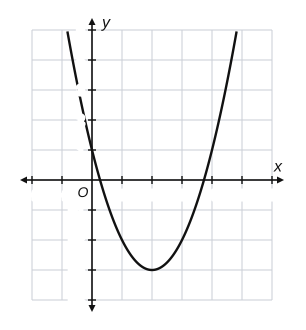
The graph of y=f(x) is shown. What is the minimum value of f(x)?
Numeric answer (you type the number).
Show answer and explanation
Answer: -3
Explanation
The minimum value of f(x) is the y-coordinate of the lowest point of the graph. The lowest point (the vertex) is (2,−3), so the minimum value is −3.
2 is the x-value where the minimum occurs, not the minimum value itself.
Question 2
Difficulty: medium≈ 1 min
For f(x)=2⋅4x, evaluate f(3).
- AA. 24
- BB. 32
- CC. 128
- DD. 512
Show answer and explanation
Correct answer: C. 128
Explanation
f(3)=2⋅43=2⋅64=128.
24 multiplies 2⋅4⋅3, 32 uses 42 instead of 43, and 512 is 83, which multiplies 2 and 4 before raising to the power.
Question 3
Difficulty: hard≈ 2 min
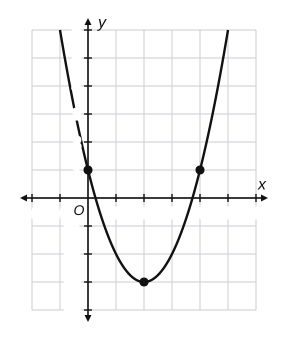
The parabola shown is the graph of a quadratic function f. Find f(7).
Numeric answer (you type the number).
Show answer and explanation
Answer: 22
Explanation
The vertex is (2,−3), so f(x)=a(x−2)2−3. The graph passes through (0,1): 1=a(4)−3, so a=1 and f(x)=(x−2)2−3. Then f(7)=52−3=22.
Check with (4,1): (2)2−3=1.
Keep practising
Other Math skills
Full SAT format · All guides